
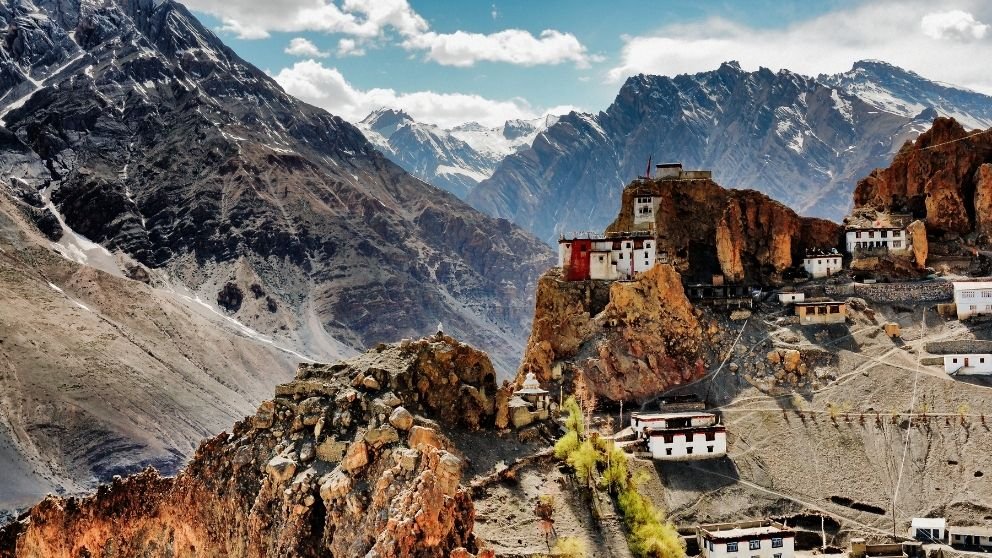
Hidden high in the Himalayas of Himachal Pradesh, Spiti Valley is a land of dramatic mountains, ancient monasteries, remote villages and roads that seem to disappear into the horizon.
The word Spiti is commonly understood as the “Middle Land”, reflecting its geographical and cultural position between India and Tibet. The district administration describes Spiti as a region that remained relatively isolated for centuries, developing a distinctive culture centred around Buddhist monasteries and high-altitude village life.
For travellers, Spiti is much more than a sightseeing destination.
It is a journey.
You ride beside the Sutlej and Spiti rivers, pass through barren mountains, stop at thousand-year-old monasteries, cross high-altitude passes and spend nights in villages where life continues at a completely different pace.
For motorcycle riders especially, a Spiti Valley bike trip is one of the most memorable road journeys in the Indian Himalayas.
Spiti Valley at a Glance
Location: Lahaul & Spiti District, Himachal Pradesh
Main Town: Kaza
Landscape: High-altitude cold desert
Main River: Spiti River
Popular Season: May to October
Famous For: Monasteries, mountain roads, remote villages, Chandratal, Buddhist culture and bike trips
Popular Routes: Shimla–Kinnaur–Spiti and Manali–Kunzum–Spiti
The Spiti River originates near the Kunzum range and eventually meets the Sutlej River at Khab in Kinnaur.
Why Is Spiti Valley Famous?
Spiti has become one of India’s best-known Himalayan road-trip destinations, but its appeal goes far beyond beautiful scenery.
Spectacular Mountain Landscapes
Spiti looks dramatically different from the greener hill regions of Himachal Pradesh.
The landscape is largely barren and rugged, with enormous mountains surrounding deep river valleys and small patches of cultivated land.
The lack of dense vegetation creates enormous open views.
At times, you can see roads winding across mountains several kilometres ahead.
It is this raw landscape that gives Spiti its unmistakable character.
Ancient Buddhist Monasteries
Buddhism is deeply connected with everyday life in Spiti.
The valley is home to several important monasteries, including:
- Key Monastery
- Tabo Monastery
- Dhankar Monastery
- Kungri Monastery
The district administration notes that Spiti’s culture historically developed around its monasteries, with Buddhism continuing to play a central role in the region.
Among them, Tabo Monastery, founded in 996 AD, is especially important for its ancient Buddhist art and long religious history.
Key Monastery, meanwhile, has become one of Spiti’s most recognizable landmarks because of its dramatic position above the valley.
Famous Places to Visit in Spiti Valley
There is far more to see in Spiti than Kaza alone.
Kaza
Kaza is the main travel base in central Spiti.
Most travellers spend at least two nights here while exploring nearby villages and monasteries.
You will find accommodation, cafés, fuel, basic motorcycle support and other essential services in Kaza.
Key Monastery
Located approximately 12 km from Kaza, Key Monastery is one of the most famous attractions in Spiti.
The monastery sits high above the Spiti River and offers incredible views across the valley.
It is commonly combined with Kibber and Chicham on a local sightseeing trip.
Kibber
Continue beyond Key and you’ll reach Kibber, a beautiful high-altitude settlement surrounded by rugged Himalayan terrain.
Walking through its traditional houses provides a glimpse into village life in this remote region.
Chicham Bridge
The impressive Chicham Bridge connects the Kibber and Chicham areas across a deep gorge.
The surrounding landscape makes it one of the most popular photography stops near Kaza.
Langza
Langza is famous for its giant Buddha statue overlooking the valley.
It is also associated with marine fossils found in the surrounding geological formations.
The combination of open landscapes, traditional houses and mountains makes Langza one of the most photogenic villages in Spiti.
Hikkim
Hikkim is best known among travellers for its post office.
Sending a postcard from this remote Himalayan village has become one of the classic experiences of a Spiti trip.
Komic
The road climbing towards Komic takes you deeper into Spiti’s high-altitude landscape.
Komic, Langza and Hikkim are generally explored together during a local trip from Kaza.
Tabo
Tabo deserves a longer stop.
Its ancient monastery complex contains historic temples, murals and Buddhist artwork and has remained an important centre of religious life for centuries.
Dhankar
Dhankar is dramatically positioned above the Spiti Valley.
The old monastery and settlement appear almost suspended above the surrounding cliffs.
The district administration places Dhankar around 32 km downstream from Kaza, at an altitude of approximately 3,870 metres.
Pin Valley
Pin Valley offers a quieter side of Spiti.
Its rugged landscapes, small villages and national park make it worth including if your itinerary allows an additional day.
Himachal Tourism notes that Pin Valley is known for high-altitude trekking routes and its distinctive rocky terrain.
Chandratal Lake
During the summer season, Chandratal Lake is one of the highlights of the complete Spiti circuit.
The lake lies beyond Kunzum Pass towards the Batal side.
Access is highly seasonal, and travellers should always check current road conditions before including Chandratal in their itinerary.
Spiti Valley by Motorcycle
For many riders, the road itself is the biggest attraction.
The journey through Spiti can include:
- Narrow Himalayan roads
- Gravel sections
- High-altitude passes
- River crossings
- Steep climbs
- Remote stretches
- Rapidly changing weather
A typical summer motorcycle circuit may follow:
Chandigarh → Shimla → Kinnaur → Nako → Tabo → Kaza → Chandratal → Manali
When the Manali–Kunzum route is closed, riders generally enter and return through the Shimla–Kinnaur side.
Spiti should not be treated as a speed ride.
Travel slowly, acclimatise properly and leave enough time for changing road conditions.
Best Time to Visit Spiti Valley
The right season depends on the experience you want.
March–April
Ideal for experienced travellers looking for a winter Spiti experience.
Expect freezing temperatures, snow and more difficult road conditions.
May
The valley begins transitioning towards summer, although Kunzum Pass and Chandratal may still remain inaccessible.
June–September
This is the main season for road trips and Spiti bike tours.
Once Kunzum Pass opens, travellers can usually attempt the complete circuit between Shimla and Manali.
October
October brings colder temperatures, fewer tourists and beautiful clear landscapes.
Road conditions should be monitored carefully as winter approaches.
Spiti Culture & Village Life
One of the biggest mistakes travellers make is experiencing Spiti entirely through tourist attractions.
Stay in a homestay.
Walk through a village.
Spend time inside a monastery.
Try local food.
Talk with your hosts.
The valley’s Buddhist traditions and long geographical isolation have created a culture that feels noticeably different from lower regions of Himachal.
Prayer flags, chortens, monasteries and traditional mud houses are part of everyday life rather than simply attractions for visitors.
How Many Days Are Enough for Spiti?
For most travellers, 7 to 10 days is a good starting point.
A comfortable itinerary should include time for:
- Kinnaur
- Nako
- Tabo
- Kaza
- Key–Kibber–Chicham
- Langza–Hikkim–Komic
- Pin Valley
- Chandratal when open
Adding extra days makes the journey more relaxed and provides flexibility if mountain conditions change.
Experience the Famous Spiti Valley
Photographs may introduce you to Spiti, but the road is what makes you understand it.
The early morning departures, ancient monasteries, tiny villages, enormous mountains and long stretches with almost no traffic create an experience that stays with you long after the journey ends.
At Spiti Riders, we organise supported Spiti Valley bike tours and provide bikes on rent for Spiti for riders who want to experience these roads on two wheels.
Whether you’re planning your first Spiti journey or returning for another ride, choose enough time to experience the valley rather than simply passing through it.
Explore our Spiti Bike Tour Packages and start planning your Himalayan ride.