
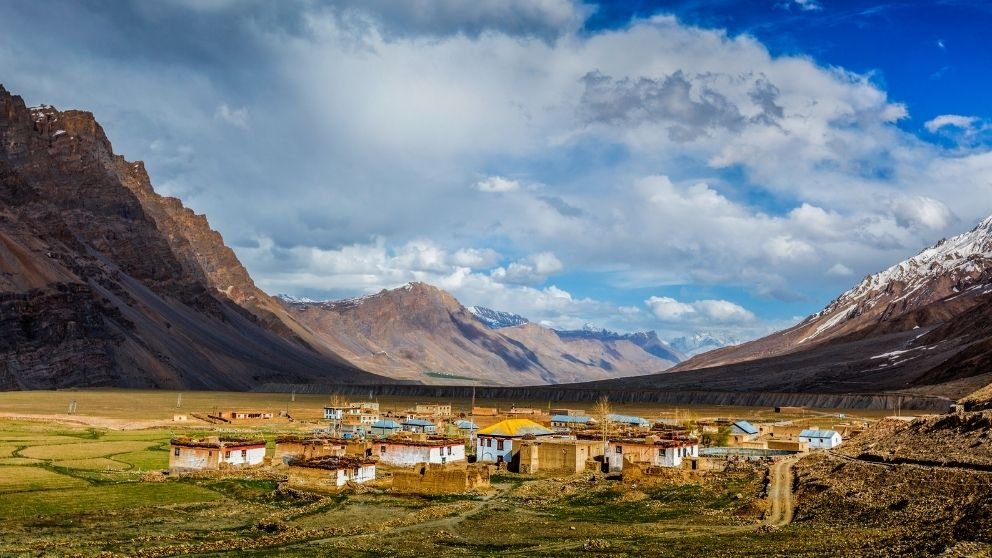
Spiti Valley is not the kind of destination where you simply arrive, visit a few tourist spots and head home.
It is a journey through high-altitude villages, ancient monasteries, rugged mountain roads, deep gorges, turquoise rivers and landscapes that seem to change every few kilometres.
Whether you’re planning a Spiti Valley bike trip, travelling by car or joining a guided tour, there are experiences here that deserve to be enjoyed slowly.
From exploring Key Monastery and sending a postcard from Hikkim to riding through remote Himalayan roads and spending a night under a sky filled with stars, here are some of the best things to do in Spiti Valley.
1. Ride the Legendary Roads of Spiti Valley
If there is one experience that defines Spiti, it is the road journey itself.
The ride into Spiti takes you through some of the most dramatic terrain in the Indian Himalayas. Depending on your route, you’ll experience narrow mountain roads, deep valleys, river crossings, rocky stretches, high-altitude passes and long sections surrounded by almost nothing except mountains.
For motorcycle riders, a Spiti Valley bike trip offers a completely different feeling from simply travelling between tourist attractions.
Every day brings a new landscape.
One moment you’re riding beside the Sutlej River and the next you’re surrounded by the barren mountains of the cold desert.
Popular routes include:
Chandigarh → Shimla → Kinnaur → Nako → Tabo → Kaza
and during the summer season:
Kaza → Kunzum Pass → Chandratal → Manali
Take your time on these roads. Spiti is about the journey just as much as the destination.
2. Visit the Iconic Key Monastery
A trip to Spiti feels incomplete without visiting Key Monastery, one of the valley’s most recognizable landmarks.
Perched dramatically above the Spiti River, the monastery appears almost as though it has grown out of the mountain itself.
Walk through its narrow corridors, prayer rooms and traditional interiors while experiencing the peaceful atmosphere of one of Spiti’s most important Buddhist centres.
The views from around the monastery are equally impressive.
From here, you can look across the vast Spiti Valley with mountains stretching far into the distance.
Distance from Kaza: Around 12 km
Best for: Culture, photography, architecture and Himalayan views
3. Explore the High-Altitude Village of Kibber
Continue beyond Key Monastery and you’ll reach Kibber, one of Spiti’s beautiful high-altitude settlements.
Traditional whitewashed houses sit against a backdrop of barren mountains, creating a landscape that feels wonderfully remote.
Spend some time simply walking through the village rather than rushing through it.
Kibber is also associated with the surrounding wildlife region, where Himalayan species including blue sheep and ibex can be found.
Winter expeditions around the broader Kibber region are particularly known among travellers hoping to spot the elusive snow leopard.
4. Cross the Spectacular Chicham Bridge
A short ride from Kibber takes you towards Chicham Bridge, one of the most impressive engineering sights on a Spiti road trip.
The bridge spans a dramatic gorge between the villages of Kibber and Chicham.
Stop at the designated area, take in the scale of the canyon below and enjoy the surrounding mountain views.
It is one of those places where photographs struggle to capture how massive the landscape actually feels.
When riding through this area, avoid stopping your motorcycle in the middle of the bridge and always leave enough space for local traffic.
5. Send a Postcard from Hikkim
In the age of instant messages, sending a handwritten postcard from the Himalayas feels surprisingly special.
Visit the famous Hikkim Post Office and send a postcard to your family, friends—or even to yourself.
Weeks later, when that postcard finally reaches home, it becomes a small reminder of your journey through Spiti.
Hikkim can easily be combined with Langza and Komic during a day trip from Kaza.
6. Meet the Giant Buddha at Langza
Langza is one of the most photogenic villages around Kaza.
The village is surrounded by wide-open mountain landscapes, but its most recognizable landmark is the large Buddha statue overlooking the valley.
Sit nearby for a while and simply enjoy the silence.
Langza is also known for fossils found in the surrounding region, a reminder that this high-altitude Himalayan landscape has an extraordinary geological history.
Travellers should avoid removing fossils or damaging the natural surroundings. Enjoy what you find and leave it where it belongs.
7. Visit Komic Village
The road climbing towards Komic is an experience in itself.
Surrounded by dramatic mountains and wide open terrain, Komic provides another glimpse into life in one of Spiti’s remote high-altitude settlements.
Visit the monastery, walk around the village and stop for a warm cup of tea before heading back towards Kaza.
Langza, Hikkim and Komic are often covered together and make one of the best local sightseeing loops around Kaza.
8. Explore the Ancient Tabo Monastery
If you’re interested in history and Buddhist culture, make time for Tabo Monastery.
Founded in 996 AD, Tabo has survived for more than a thousand years and remains one of the most culturally important places in the valley.
Unlike monasteries dramatically positioned on mountain tops, the older structures at Tabo sit quietly within the village.
The simple mud architecture hides remarkable religious artwork and centuries of history.
You can also explore the meditation caves located on the hillside opposite the monastery.
Distance from Kaza: Approximately 48–50 km
Best for: History, Buddhism, architecture and slow travel
9. Experience the Dramatic Setting of Dhankar
Few villages in Spiti have a setting as dramatic as Dhankar.
The old monastery and village sit high above the meeting area of the Spiti and Pin river valleys, surrounded by steep mountains and eroded cliffs.
The road climbing towards Dhankar offers excellent viewpoints along the way.
Once you arrive, spend time exploring the village and monastery before heading towards the viewpoint.
For travellers with enough time and suitable fitness, Dhankar can also be the starting point for the hike towards Dhankar Lake.
10. Discover the Beauty of Pin Valley
After several days surrounded by Spiti’s brown and grey mountain landscape, entering Pin Valley brings another character to the journey.
The valley feels quieter and more isolated, with small villages scattered between mountains and the Pin River running through the landscape.
Mud Village is one of the best-known stops inside Pin Valley and makes a good destination for travellers who want to experience a slower side of Spiti.
Instead of rushing through, consider spending a night in a local homestay.
Morning and evening are particularly peaceful here.
11. Spend Time Around Kaza
Many travellers treat Kaza only as a place to sleep between sightseeing trips, but it deserves some time of its own.
Kaza is the main base for exploring central Spiti and one of the best places to take a break after several long days on the road.
Walk around the market, visit local cafés, talk to fellow travellers, shop for small local products and enjoy a relaxed evening.
It’s also the place to prepare for the next stage of your journey.
If you’re travelling by motorcycle, use your time in Kaza to check:
- Tyre pressure
- Chain lubrication
- Engine oil
- Brake condition
- Fuel level
- Luggage mounting
- Basic tools and puncture repair equipment
Once you leave Kaza towards more remote areas, services become increasingly limited.
12. Visit Nako Lake and Village
For travellers entering Spiti through the Shimla–Kinnaur route, Nako is usually one of the memorable stops before reaching the heart of the valley.
The small settlement is built around Nako Lake, surrounded by traditional houses, mountains and quiet walking paths.
After a long riding day, walking around the lake in the evening can be particularly relaxing.
Nako’s slower atmosphere also makes it a useful overnight stop while gradually gaining altitude on the journey towards Spiti.
13. Stop at Gue Village
A short diversion from the main route takes travellers towards Gue Village, close to the Indo-Tibetan border region.
The village is known for the naturally preserved mummy of a Buddhist monk kept inside a small temple.
Beyond the unusual attraction itself, the ride towards Gue is beautiful and far quieter than many of Spiti’s more famous sightseeing routes.
It makes an interesting addition when travelling between Nako and Tabo.
14. Experience Chandratal Lake
For many travellers, Chandratal Lake becomes one of the highlights of the entire Spiti trip.
Surrounded by mountains at high altitude, the crescent-shaped lake changes colour depending on the light and weather.
Walk slowly from the parking area towards the lake and avoid unnecessary physical exertion because of the altitude.
The region becomes even more magical as evening approaches.
Depending on seasonal road conditions, travellers can stay at designated camps in the broader Chandratal area before continuing towards Batal and Manali.
Important
Access to Chandratal is seasonal and depends heavily on snow clearance and road conditions.
Never build your complete Spiti itinerary around Chandratal without checking the latest road situation before travelling.
15. Cross Kunzum Pass
The journey between Spiti and Lahaul takes you across the spectacular Kunzum Pass.
Prayer flags, snow-covered peaks and huge open landscapes create one of the most memorable scenes of the journey.
Many travellers traditionally stop near the Kunzum Mata temple before continuing their journey.
Weather can change quickly at these elevations, so avoid spending unnecessarily long periods at the pass if conditions begin deteriorating.
For motorcycle riders, the road around Kunzum and towards Batal is also one of the more demanding sections of a summer Spiti ride.