
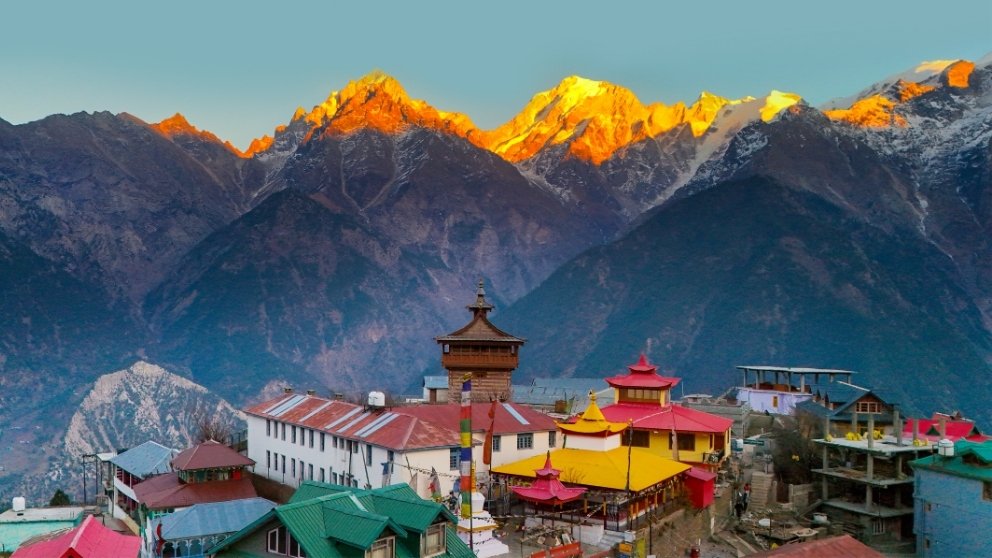
There are places in the Himalayas where the journey itself is the biggest attraction. And then there are places where, after hours of travelling through winding mountain roads, you reach your destination and immediately realise why the journey was worth it.
Kalpa Village in Kinnaur is one of those places.
Imagine waking up in a quiet Himalayan village, opening your window and seeing enormous snow-covered mountains standing directly in front of you. As the first sunlight touches the peaks, the mountains slowly change colour from white to golden and pink.
Below them are traditional wooden houses, apple orchards and peaceful village streets.
This is what makes Kalpa special.
Located in the Kinnaur district of Himachal Pradesh, Kalpa is famous for its breathtaking views of the Kinner Kailash mountain range, traditional Kinnauri architecture and beautiful apple orchards.
For travellers planning a Spiti Valley road trip, Kalpa is also an excellent place to stop before continuing towards Nako, Tabo and Kaza.
Whether you’re exploring Himachal Pradesh by motorcycle, travelling with family or planning a peaceful mountain holiday, this guide covers everything you need to know about visiting Kalpa.
Where Is Kalpa Village Located?
Kalpa is a traditional Himalayan village situated above Reckong Peo, the district headquarters of Kinnaur in Himachal Pradesh.
The village lies along the historic Hindustan–Tibet Road region and overlooks the dramatic mountain landscape of the Sutlej Valley.
According to the Kinnaur district administration, Kalpa is situated at an altitude of approximately 2,759 metres above sea level.
Its elevated position provides spectacular views of the snow-covered Kinner Kailash range, one of the most recognisable mountain landscapes in Kinnaur.
Unlike popular tourist towns filled with commercial activities, Kalpa retains much of its traditional atmosphere.
Small village lanes, wooden houses, temples, monasteries and fruit orchards are all part of everyday life here.
Kalpa Village at a Glance
| Information | Details |
|---|---|
| Location | Kinnaur, Himachal Pradesh |
| Altitude | Approx. 2,759 metres |
| Famous for | Kinner Kailash views and apple orchards |
| Distance from Shimla | Approx. 260 km |
| Distance from Reckong Peo | Approx. 13–14 km |
| Distance from Nako | Approx. 119 km |
| Best time to visit | April–June and September–October |
| Ideal stay | 1–2 nights |
| Popular attractions | Kinner Kailash, Narayan Nagini Temple, Roghi Village |
| Accommodation | Hotels, guesthouses and homestays |
Why Is Kalpa Village Famous?
Kalpa is best known for its incredible views of the Kinner Kailash mountain range.
But that isn’t the only reason travellers visit this destination.
The village combines natural beauty, traditional Kinnauri culture, ancient religious sites and some of the most scenic mountain roads in Himachal Pradesh.
1. Spectacular Views of Kinner Kailash
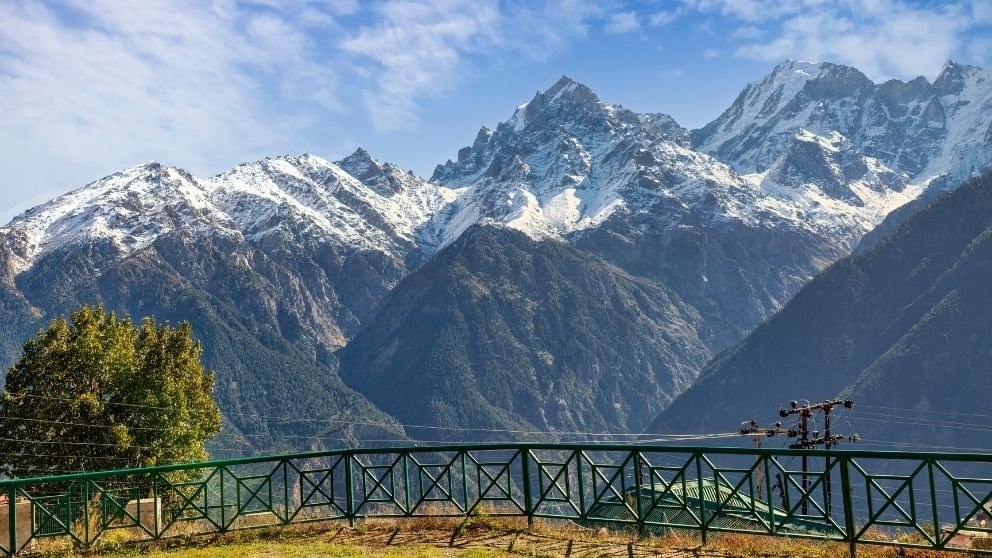
The most remarkable feature of Kalpa is its location directly opposite the Kinner Kailash mountain range.
The snow-covered mountains appear almost close enough to touch, particularly on clear days.
What makes the experience even more special is how the mountains change throughout the day.
Early in the morning, the rising sun illuminates the peaks with golden and reddish light. As the day progresses, the colours shift depending on the weather and position of the sun.
For photographers, this changing mountain scenery is one of Kalpa’s biggest attractions.
2. Beautiful Apple Orchards
Kinnaur is famous for its apple production, and Kalpa is surrounded by orchards.
During spring, the trees may be covered in delicate blossoms.
Later in the year, apples begin ripening and the orchards become particularly attractive.
The combination of fruit trees, traditional village houses and snow-covered mountains creates a landscape that feels very different from the barren terrain further towards Spiti.
3. Traditional Kinnauri Culture
Kalpa is also known for its rich cultural heritage.
Traditional wooden architecture, local temples, Buddhist monasteries and agricultural lifestyles reflect Kinnaur’s distinctive Himalayan identity.
The influence of both Hindu and Buddhist traditions can be seen throughout the region.
4. An Important Stop on the Spiti Valley Route
For people travelling towards Spiti Valley through Shimla and Kinnaur, Kalpa is a convenient destination to include in the journey.
It allows travellers to enjoy the greener mountain landscapes of Kinnaur before continuing towards the increasingly dry terrain of upper Kinnaur and Spiti.
Best Places to Visit in Kalpa Village
Although Kalpa is a relatively small destination, there are several interesting places worth exploring.
Some are within the village itself, while others require a short drive.
1. Kinner Kailash Mountain View
If there is one reason to visit Kalpa, it is the incredible view of Kinner Kailash.
The mountain range rises dramatically above the valley, creating an unforgettable Himalayan backdrop.
Kinner Kailash is also considered sacred in local Hindu traditions and is associated with Lord Shiva.
One of the most fascinating features of the range is the Kinner Kailash Shivling, a distinctive natural rock formation that holds religious significance.
The mountain scenery can be enjoyed from several hotels, village viewpoints and open areas around Kalpa.
Best time for photography: Early morning, particularly around sunrise, when the first light touches the snowy peaks.
You don’t necessarily need to travel to a separate viewpoint. Many parts of Kalpa offer beautiful views when the skies are clear.
2. Narayan Nagini Temple
The Narayan Nagini Temple is one of Kalpa’s important cultural and architectural attractions.
The temple complex is known for its traditional wooden craftsmanship and distinctive Kinnauri architectural style.
Beautifully carved woodwork and local religious traditions make it a worthwhile stop for travellers interested in Himalayan culture.
The temple reflects the region’s long-established relationship between community life, architecture and religious practices.
Visitors should dress respectfully and follow local rules regarding photography and access.
3. Hu-Bu-Lan-Kar Monastery
Kalpa is also home to the historic Hu-Bu-Lan-Kar Monastery, sometimes written as Hu-Bu-Ian-Car Gompa.
The monastery is traditionally associated with the Buddhist scholar and translator Rinchen Zangpo.
It is an important part of Kalpa’s Buddhist cultural heritage.
The monastery features traditional religious architecture, prayer spaces and Buddhist symbolism.
For travellers exploring the monasteries of Kinnaur and Spiti, this is a meaningful stop before continuing towards Nako and Tabo.
Although it is smaller than some of Spiti’s famous monasteries, its historical and cultural importance makes it worth visiting.
4. Roghi Village
Roghi is a small traditional village located a few kilometres from Kalpa.
The drive towards Roghi is one of the most scenic short journeys in the area.
The road passes through mountain landscapes, orchards and narrow sections overlooking the deep Sutlej Valley.
Roghi itself retains a traditional rural atmosphere, with wooden houses, agricultural fields and beautiful views.
This is an excellent place to experience a quieter side of Kinnaur.
The Famous Roghi Cliffside Viewpoint
Along the road towards Roghi is a dramatic cliffside location sometimes referred to by travellers as Suicide Point.
The location is known for its steep drop and dramatic mountain views.
However, the road can be narrow, and exposed sections may be dangerous.
Important: Never stand near an unprotected edge or climb barriers for photographs. Stop only where parking is safe, and avoid obstructing local traffic.
The scenery is impressive enough to enjoy from a safe distance.
5. Explore Kalpa’s Apple Orchards
One of the simplest and most enjoyable experiences in Kalpa is walking through areas surrounded by apple orchards.
The orchards are particularly attractive during spring blossoms and the autumn fruit season.
You may see local residents working in the orchards, maintaining trees or preparing produce for transportation.
Apple farming is an important part of Kinnaur’s economy and local lifestyle.
If you want to enter an orchard or take photographs of people working there, ask permission first.
These are working farms, not public gardens.
6. Walk Through Old Kalpa Village
Kalpa is best experienced slowly.
Instead of spending the entire day driving between viewpoints, take some time to explore the village on foot.
You’ll notice traditional houses, wooden balconies, stone pathways and small spaces where daily life continues much as it has for generations.
Some buildings display the distinctive timber-and-stone construction associated with Kinnauri architecture.
Walking through the village offers a different perspective from simply enjoying the mountain views from a hotel.
It’s also a good opportunity to experience the slower pace of life in the Himalayan region.
Sunrise in Kalpa: An Experience Worth Waking Up Early For
One of the most memorable experiences in Kalpa is watching the sunrise over the Kinner Kailash range.
Unlike many destinations where you must drive to a specific viewpoint, Kalpa offers impressive mountain views from several locations within the village.
On a clear morning, the mountain peaks begin catching sunlight while the village below remains partly in shadow.
The snow-covered ridges gradually turn golden, creating a remarkable contrast against the morning sky.
This is one of the reasons an overnight stay in Kalpa is highly recommended.
If you arrive in the afternoon and leave early the next day without spending time outdoors, you may miss the experience that makes Kalpa so special.
For photographers, keeping the morning free for mountain photography is a good idea.
Weather can change quickly, so clear views are never guaranteed.
How to Reach Kalpa Village
Kalpa is connected by road through Reckong Peo and can be reached from Shimla, Sangla and other destinations in Kinnaur.
The journey is an important part of the experience, as the route passes through some of Himachal Pradesh’s most dramatic mountain scenery.
Shimla to Kalpa Route
Route: Shimla → Narkanda → Rampur → Jeori → Karcham → Reckong Peo → Kalpa
The road follows the famous Hindustan–Tibet highway region through the Sutlej Valley.
Travellers leaving Shimla initially pass through greener mountain landscapes around Narkanda.
As the journey progresses towards Rampur and Kinnaur, the roads become more dramatic.
You’ll encounter deep valleys, steep mountain slopes, rock-cut road sections and beautiful river views.
The final approach involves climbing from Reckong Peo towards Kalpa.
The total journey is approximately 260 kilometres, according to the Kinnaur district administration.
However, mountain road conditions can make travel considerably slower than the distance suggests.
Is It Possible to Reach Kalpa from Shimla in One Day?
Yes, experienced drivers and riders may complete the journey in a day when road and weather conditions are favourable.
However, it is a long mountain journey.
If you want a more relaxed experience, consider breaking the trip with an overnight stay around Narkanda, Sarahan or another suitable location.
This also gives you more time to appreciate the scenery rather than treating the journey as a race to the destination.
Reckong Peo to Kalpa
Reckong Peo is the main administrative and commercial centre of Kinnaur.
Kalpa is located approximately 13–14 kilometres uphill from Reckong Peo.
The drive passes through a scenic hillside landscape with orchards and views of the surrounding valley.
Reckong Peo is a useful place to arrange supplies, transportation or other essential services before continuing further into upper Kinnaur.
Sangla to Kalpa
Travellers exploring Sangla Valley can visit Kalpa after returning towards the main Kinnaur highway.
The journey is approximately 50 kilometres, depending on the route.
Sangla and Kalpa offer very different experiences.
Sangla is known for its beautiful Baspa River valley, traditional villages and relatively green mountain scenery.
Kalpa is especially famous for its wide views of Kinner Kailash and peaceful hillside setting.
Combining these destinations is an excellent way to experience the diversity of Kinnaur.
Kalpa to Nako
Route: Kalpa → Reckong Peo → Pooh → Khab → Nako
Nako is approximately 119 kilometres from Kalpa.
This is one of the most fascinating stretches of the Kinnaur–Spiti journey because the landscape changes significantly along the way.
As you travel towards upper Kinnaur, dense greenery gradually gives way to dry, rocky mountain terrain.
Near Khab, travellers can observe the dramatic meeting point of the Sutlej and Spiti rivers.
After this, the route climbs towards Nako, a beautiful high-altitude village known for its lake and ancient Buddhist monastery.
For motorcycle enthusiasts, the Kalpa-to-Nako journey is one of the memorable sections of a Spiti Valley road trip.
Best Time to Visit Kalpa Village
Kalpa offers a different experience in every season.
However, certain months are generally more comfortable for sightseeing and motorcycle touring.
April to June: Spring and Early Summer
April, May and June are excellent months to explore Kalpa.
The weather becomes more comfortable after winter, and the surrounding mountains may still be covered in snow.
Spring is particularly beautiful because of the apple blossoms.
During April, depending on the weather and elevation, orchards begin showing signs of new growth and flowering.
May and June are generally suitable for sightseeing, village walks and exploring Kinnaur.
Even during summer, evenings can be cold, so carry warm clothing.
July to August: Monsoon Season
July and August bring the monsoon season to parts of Himachal Pradesh.
While upper Kinnaur receives less rainfall than some lower Himalayan regions, the approach roads can still experience landslides, rockfall and road closures.
The mountain landscape may look greener, but road travel requires additional caution.
For motorcycle riders, this period can be particularly challenging because of slippery surfaces and unpredictable weather.
Check road conditions and allow flexibility in your schedule.
September to October: Apple Season and Clear Mountain Views
September and October are among the most attractive months to visit Kalpa.
The monsoon gradually withdraws, and clear weather can provide spectacular views of the Kinner Kailash range.
This is also an important period for apple harvesting in parts of Kinnaur.
The orchards, traditional houses and surrounding mountains create beautiful autumn scenery.
For travellers interested in photography, local culture and relaxed mountain journeys, September is an excellent choice.
November to March: Winter in Kalpa
Winter transforms Kalpa into a cold Himalayan settlement.
Snowfall may cover the village and surrounding mountains, particularly during the colder winter months.
The landscape can be beautiful, but road access and accommodation facilities may be affected.
Some properties may close temporarily, and icy roads can make travel difficult.
Winter trips require careful planning, suitable vehicles and updated local road information.
For most travellers, April to June and September to October are the best times to visit Kalpa.
Where to Stay in Kalpa Village
Kalpa has a variety of accommodation options, including hotels, guesthouses and locally operated homestays.
Many travellers choose Kalpa specifically for the mountain views.
If you’re planning an overnight stay, look for accommodation with clear views of the Kinner Kailash range.
However, a room advertised as mountain-facing does not always guarantee an unobstructed view.
Check recent photographs or confirm the room’s location before booking.
Should You Stay in Kalpa or Reckong Peo?
Both destinations can work as overnight stops, but they offer different experiences.
Choose Kalpa if you want:
- Beautiful Kinner Kailash views.
- A peaceful village atmosphere.
- Easy access to traditional temples and monasteries.
- Sunrise photography.
- A relaxing stay surrounded by orchards.
Choose Reckong Peo if you want:
- Easier access to transport connections.
- Shops, supplies and commercial facilities.
- A practical base for administrative or transport arrangements.
- Convenient access to the main highway.
For travellers whose priority is sightseeing and experiencing Kinnaur’s natural beauty, Kalpa is generally the more attractive overnight destination.
Kalpa on a Spiti Valley Bike Trip
For motorcycle riders, Kalpa is more than just another stop on the itinerary.
It offers a chance to experience the changing landscapes of Himachal Pradesh as the journey moves from the greener mountains of Shimla towards the high-altitude cold desert of Spiti.
The roads around Kinnaur are among the most scenic parts of the journey.
You’ll ride beside the Sutlej River, pass dramatic rock formations and gradually gain elevation.
After several hours of riding, reaching Kalpa provides an excellent opportunity to rest and enjoy the mountain views.
Why Riders Should Include Kalpa
Kalpa works particularly well as a stop because it offers accommodation, sightseeing and access to the next section of the Kinnaur–Spiti route.
It also allows riders to explore an important cultural destination rather than spending the entire journey focused only on riding.
A morning in Kalpa can include watching the sunrise, visiting the monastery and exploring the traditional village streets.
You can then continue towards Nako if your itinerary and road conditions allow.
Motorcycle Riding Tips for Kalpa
- Start early to avoid riding on mountain roads after dark.
- Check tyre pressure, brakes and chain condition before departure.
- Ride cautiously through rockfall-prone sections of the Kinnaur highway.
- Avoid overtaking on blind mountain corners.
- Keep enough fuel for the next planned section.
- Carry a waterproof jacket and warm riding layers.
- Download offline maps before entering areas with weak connectivity.
- Avoid parking near unstable slopes or below loose rocks.
- Allow time for photography and rest breaks.
The roads may be spectacular, but rider safety should always come before speed or ambitious daily targets.
At Spiti Riders, we believe the experience of travelling through Kinnaur is just as important as reaching Spiti Valley.
Our locally managed motorcycle tours focus on exploring the region’s roads, villages and landscapes while allowing for practical travel planning.
Explore our Spiti Valley Bike Tour Packages to plan your next Himalayan adventure.
Places to Visit Near Kalpa
Kalpa can also serve as a base for exploring other destinations in Kinnaur.
1. Reckong Peo
Located just below Kalpa, Reckong Peo is the district headquarters of Kinnaur.
It is an important administrative and commercial centre with transport connections and shopping facilities.
2. Kothi Village
Kothi is a traditional village near Reckong Peo and Kalpa.
It is known for its local culture, traditional architecture and peaceful mountain setting.
Travellers interested in village life and Kinnauri heritage may enjoy visiting Kothi.
3. Sangla Valley
Sangla is one of Kinnaur’s most beautiful valleys.
The Baspa River, traditional villages, orchards and mountain scenery make it a popular destination.
It can be combined with Kalpa in a longer Kinnaur itinerary.
4. Chitkul Village
Chitkul is located further into the Baspa Valley beyond Sangla.
It is famous for its traditional wooden houses and impressive mountain scenery.
If you’re exploring Kinnaur before entering Spiti Valley, Chitkul is a worthwhile detour.
Read our Chitkul Village Travel Guide to learn more.
5. Nako Village
Nako lies further along the route towards Spiti Valley.
The village is known for its beautiful lake, ancient monastery and dramatic high-altitude surroundings.
For riders continuing towards Tabo and Kaza, Nako is a natural destination after Kalpa.
Suggested Spiti Valley Itinerary Including Kalpa
Kalpa fits naturally into a multi-day Kinnaur and Spiti Valley road trip.
Here is an illustrative eight-day route for travellers planning a summer motorcycle circuit.
| Day | Suggested Route |
|---|---|
| Day 1 | Shimla to Narkanda |
| Day 2 | Narkanda to Sangla or Chitkul |
| Day 3 | Chitkul to Kalpa |
| Day 4 | Kalpa to Nako and Tabo |
| Day 5 | Tabo to Kaza via Dhankar Monastery |
| Day 6 | Explore Key Monastery, Kibber and Kaza |
| Day 7 | Kaza to Chandratal via Kunzum Pass |
| Day 8 | Chandratal to Manali |
This itinerary is a sample route, not a fixed schedule.
Travellers can adjust the journey depending on road conditions, available days and personal preferences.
During months when Kunzum Pass and the Chandratal route are closed, a return journey through Kinnaur is generally more practical.
For travellers who have more time, spending an extra night in Kalpa can make the experience more enjoyable.
Practical Travel Tips Before Visiting Kalpa
A little preparation can help you enjoy Kalpa without unnecessary difficulties.
Mobile Connectivity
Network availability can vary along the Kinnaur highway.
Connectivity is generally more accessible around major settlements, but some mountain-road sections may have weak or unreliable signals.
Keep offline maps and essential booking details available.
Petrol and Vehicle Supplies
Reckong Peo and the main Kinnaur route provide opportunities to arrange fuel and basic supplies.
However, petrol stations become less frequent as you continue towards upper Kinnaur and Spiti.
Always plan refuelling before entering remote sections.
Cash and Payments
Carry some cash for small shops, local eateries and unexpected expenses.
Digital payments may not always be reliable in locations with weak internet connectivity.
Clothing
Kalpa can feel cold even during the summer evenings.
Carry a warm jacket, comfortable walking shoes and suitable rain protection.
Respect Local Culture
Kinnaur has a rich cultural identity.
Visitors should respect religious traditions, follow temple rules and avoid entering private orchards without permission.
Responsible tourism helps preserve the character of small Himalayan communities.
Frequently Asked Questions About Kalpa Village
1. Where is Kalpa Village located?
Kalpa Village is located in the Kinnaur district of Himachal Pradesh, approximately 13–14 kilometres uphill from Reckong Peo.
2. What is Kalpa famous for?
Kalpa is famous for its panoramic views of the Kinner Kailash mountain range, apple orchards, traditional Kinnauri architecture, Narayan Nagini Temple and Buddhist monastery.
3. What is the altitude of Kalpa Village?
The Kinnaur district administration lists Kalpa at approximately 2,759 metres above sea level. Some travel references quote higher elevations for parts of the surrounding settlement.
4. What is the best time to visit Kalpa?
April to June and September to October are generally the best periods for sightseeing. Spring offers orchard blossoms, while autumn is attractive for clear mountain views and the apple season.
5. How far is Kalpa from Shimla?
Kalpa is approximately 260 kilometres from Shimla, according to the district administration. Journey time depends on road and weather conditions.
6. Is Kalpa worth visiting during a Spiti Valley trip?
Yes. Kalpa is one of the most scenic stops along the Shimla–Kinnaur–Spiti route and offers an opportunity to enjoy the Kinner Kailash range before continuing towards Nako and Kaza.
7. How many days are enough for Kalpa?
One night is enough for a brief visit, but two nights allow more time for sightseeing, mountain photography and exploring nearby villages.
8. Can we visit Kalpa in winter?
Yes, when road conditions permit. However, snowfall, freezing temperatures and icy roads can create challenges, so winter travel requires additional preparation.
9. Is Kalpa suitable for a motorcycle trip?
Yes. Kalpa is a popular stop for riders exploring Kinnaur and Spiti Valley. The roads are scenic but require experience and caution because of narrow sections, steep slopes and possible rockfall.
10. Is Kalpa better than Sangla?
Both destinations offer different experiences. Kalpa is especially attractive for Kinner Kailash views and traditional hillside scenery, while Sangla is known for the beautiful Baspa Valley, riverside landscapes and access to Chitkul. Visiting both is ideal if your itinerary allows.
Final Thoughts: Why Kalpa Deserves a Place in Your Himalayan Journey
Kalpa is a destination that doesn’t need too many attractions to impress travellers.
The view of Kinner Kailash alone is enough to make the journey memorable.
But once you spend time in the village, you discover that its charm goes far beyond the mountains.
Traditional houses, apple orchards, ancient temples, Buddhist monasteries and the peaceful atmosphere create an experience that is difficult to find in larger tourist destinations.
For motorcycle riders, Kalpa also marks an important stage of the journey towards Spiti Valley.
It is where the roads become increasingly dramatic and the landscape begins transitioning towards the remote Himalayan regions ahead.
Whether you spend a quiet morning watching the sunrise or explore the surrounding villages, Kalpa gives you a reason to slow down and enjoy the Himalayas.
Planning a Spiti Valley Bike Trip?
At Spiti Riders, we’re a locally operated travel team that manages our motorcycle tours directly rather than simply passing bookings to third-party operators.
We help travellers explore Kinnaur and Spiti Valley through carefully planned journeys that combine scenic riding, local culture and Himalayan adventure.
Discover our Spiti Valley Bike Tour Packages and start planning your next mountain journey.
Spiti Riders — Ride Beyond the Ordinary.