
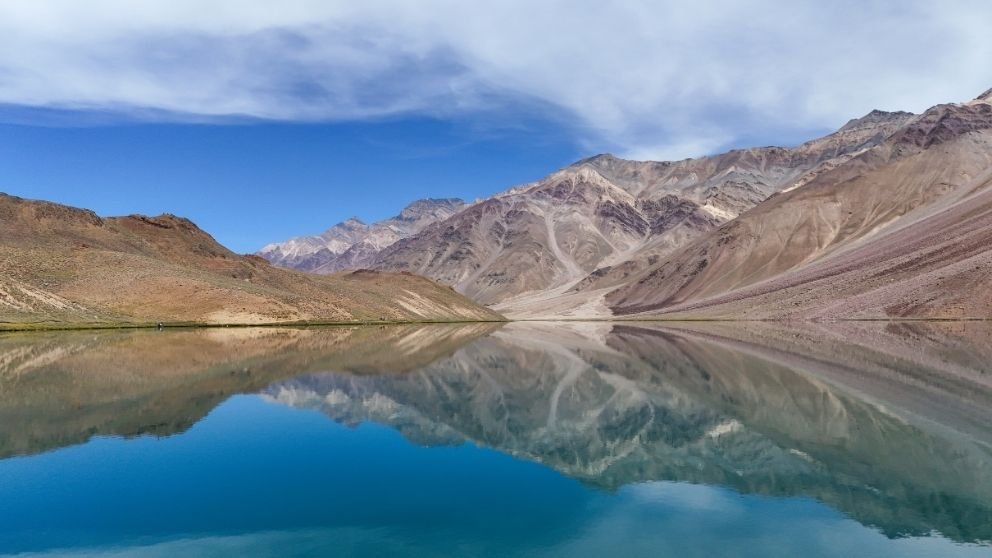
Some destinations in the Himalayas are beautiful because of their mountains. Others are memorable because of the journey required to reach them.
Chandratal Lake offers both.
Imagine riding through the rugged mountains of Spiti Valley, crossing Kunzum Pass, navigating narrow Himalayan roads and finally reaching a beautiful blue lake surrounded by enormous mountain peaks.
There are no busy markets, permanent hotels or crowded streets beside the water. Just a peaceful high-altitude lake, open skies and the extraordinary landscape of the Trans-Himalayan region.
Located at approximately 4,300 metres above sea level, Chandratal Lake is one of the most spectacular natural attractions in Himachal Pradesh.
Also known as the Lake of the Moon, it is famous for its crescent shape, crystal-clear water, mountain reflections and remarkable surroundings.
For travellers planning a Spiti Valley bike trip, Chandratal is often one of the most anticipated destinations of the entire journey.
However, reaching the lake requires proper planning. The approach roads are rough, the weather can change rapidly, and the high altitude makes preparation essential.
In this guide, we’ll explore everything you need to know about Chandratal Lake, including how to reach it from Kaza and Manali, the best time to visit, camping arrangements, the final walk to the lake and important travel tips.
Where Is Chandratal Lake Located?
Chandratal Lake is located in the Lahaul and Spiti district of Himachal Pradesh, close to Kunzum Pass.
Although the lake is commonly included in Spiti Valley travel itineraries, it lies on the Lahaul side of the Kunzum mountain divide, within the upper Chandra Valley.
The lake sits in a remote Himalayan landscape surrounded by rocky mountains, alpine meadows and seasonal snowfields.
It is part of the protected Chandratal Wildlife Sanctuary and is internationally recognised as an important wetland under the Ramsar Convention.
Unlike destinations such as Kaza or Tabo, Chandratal has no permanent tourist settlement beside the lake.
Access is seasonal, and visitors generally arrive using the road connecting Kaza and Manali through Kunzum Pass.
Chandratal Lake at a Glance
| Information | Details |
|---|---|
| Location | Lahaul and Spiti, Himachal Pradesh |
| Altitude | Approximately 4,300 metres |
| Also known as | Moon Lake / Chandra Taal |
| Famous for | Crescent shape, lake reflections and Himalayan scenery |
| Distance from Kaza | Approximately 100 km |
| Distance from Manali | Approximately 130 km |
| Distance from Batal | Approximately 12–14 km to the lake access area |
| Final approach | Around 1–1.5 km walk from parking |
| Best travel period | Generally July to September |
| Accommodation | Permitted seasonal camps away from the lake |
| Winter accessibility | Usually inaccessible by road |
| Protected status | Ramsar wetland and wildlife sanctuary |
Distances are approximate. Actual road access, parking locations and seasonal arrangements can change.
Why Is Chandratal Lake So Famous?
Chandratal is not the largest lake in Himachal Pradesh, but its setting makes it one of the most extraordinary.
The lake is surrounded by enormous mountains, with very little human development in the immediate landscape.
The combination of altitude, water clarity and dramatic scenery creates an experience that feels completely different from visiting a typical tourist destination.
1. Its Beautiful Crescent Shape
The name Chandratal comes from the words Chandra, meaning moon, and Tal, meaning lake.
The lake is famous for its curved, crescent-like shape, which resembles the moon when viewed from an elevated perspective.
This distinctive appearance is one of the reasons it is known as the Moon Lake.
2. Changing Colours of the Water
One of Chandratal’s most fascinating features is the appearance of its water.
Depending on the sunlight, weather, viewing angle and reflections, the lake may appear deep blue, turquoise or greenish.
On calm days, the surrounding mountains can reflect beautifully across the surface.
The contrast between the clear water and barren Himalayan terrain is particularly impressive.
3. A Remote Himalayan Landscape
Chandratal is located far away from major towns and conventional tourist facilities.
The surrounding mountains, open meadows and peaceful environment create a feeling of complete isolation.
For many visitors, this is the real attraction.
There is very little to distract you from the natural surroundings.
4. An Important Destination on Spiti Bike Trips
For motorcycle travellers, reaching Chandratal is not simply about visiting a lake.
The journey includes crossing Kunzum Pass and navigating some of the most challenging roads in the region.
The landscape, the ride and the destination come together to make Chandratal one of the most memorable stops on a summer Spiti circuit.
The Story Behind Chandratal Lake
Like many places in the Himalayas, Chandratal is associated with local legends and religious traditions.
One well-known story connects the lake with the Mahabharata.
According to the legend, Yudhishthira, the eldest of the Pandavas, was taken to heaven by Lord Indra from the area associated with Chandratal.
The story has become an important part of the lake’s cultural identity.
Local traditions also regard the lake as sacred, and visitors are expected to respect its spiritual significance.
These stories are part of the region’s cultural heritage rather than historically verified events.
Beyond the legends, Chandratal has considerable environmental importance.
In 2005, Chandertal Wetland was designated a Ramsar site, recognising its international significance for wetland conservation.
How to Reach Chandratal Lake from Kaza
Kaza is one of the most convenient starting points for visiting Chandratal Lake.
The journey offers a spectacular combination of mountain roads, traditional villages and high-altitude landscapes.
Kaza to Chandratal Lake Route
Kaza → Losar Village → Kunzum Pass → Chandratal Road Junction → Chandratal Parking Area → Walk to the Lake
The total road distance to the lake access area is approximately 100 kilometres, depending on the exact route.
The journey begins in Kaza and follows the main road through the upper Spiti Valley.
As you ride towards Losar, the landscape becomes increasingly remote.
After Losar, the road climbs towards Kunzum Pass, one of the most famous mountain passes in Himachal Pradesh.
At approximately 4,551 metres, Kunzum Pass provides incredible views of the surrounding Himalayan landscape.
From the pass, the road descends towards Batal.
A narrow side road branches off towards Chandratal Lake.
The final motorable section leads towards the seasonal camping and parking areas, from where visitors continue on foot.
How Long Does It Take from Kaza?
Allow approximately 4–6 hours or more for the road journey, depending on road conditions, vehicle type, weather and photography stops.
The final walk and time spent at the lake require additional time.
On these mountain roads, distance alone is not a reliable way to estimate travel duration.
Is the Kaza Route Better for Chandratal?
For many travellers, particularly those following a longer Spiti itinerary through Kinnaur, approaching Chandratal from Kaza is a sensible option.
You may already have spent several days travelling through the region and gradually adjusting to higher elevations.
However, altitude sickness can still occur, and previous nights spent at altitude do not guarantee complete acclimatisation.
The Kaza approach also allows travellers to include Chandratal as one of the final destinations before continuing towards Manali.
How to Reach Chandratal Lake from Manali
Travellers can also reach Chandratal from Manali during the summer season when the road across Kunzum Pass is accessible.
However, this journey involves some particularly rough road sections.
Manali to Chandratal Lake Route
Manali → Atal Tunnel → Koksar → Gramphu → Chhatru → Chhota Dhara → Batal → Chandratal Road Junction → Chandratal Lake
The total distance is approximately 130 kilometres, depending on the starting point and final parking area.
After travelling through the Atal Tunnel, the route enters the Lahaul region.
Near Gramphu, travellers leave the main highway and continue towards Chhatru and Batal.
This section is famous for its challenging terrain.
You may encounter broken roads, loose stones, narrow tracks and seasonal water crossings.
Near Batal, a side road leads towards Chandratal.
Why Is the Manali Route Challenging?
The road between Gramphu and Batal is often one of the most demanding parts of a Spiti Valley journey.
Even experienced riders can find sections challenging after snowfall, heavy rain or road damage.
Water crossings may become deeper during the afternoon because of melting snow.
Some sections have limited space for vehicles to pass each other.
A road that looks relatively short on a map can therefore take several hours.
Travel tip: Begin the journey early, confirm the road status and avoid travelling after dark.
Travellers approaching directly from Manali should also consider the rapid altitude gain before planning an overnight stay near Chandratal.
Chandratal Lake Trek: How Far Do You Need to Walk?
One of the most common questions travellers ask is whether they can take their motorcycle or car directly to Chandratal Lake.
The answer is no.
Vehicles must stop at the permitted parking area, and the final section is completed on foot.
Chandratal Lake Walk Details
| Information | Details |
|---|---|
| Starting point | Designated parking area |
| Walking distance | Approx. 1–1.5 km one way |
| Difficulty | Generally easy terrain, but challenging altitude |
| Approximate duration | 20–45 minutes one way |
| Trail | High-altitude walking path |
| Lake altitude | Around 4,300 metres |
The exact walking distance can vary depending on where vehicles are permitted to park.
What Is the Walk Like?
The trail leading towards Chandratal passes through an open, high-altitude landscape.
Unlike the steep climb to Dhankar Lake, the usual approach to Chandratal involves comparatively gentle terrain.
However, the altitude makes even a short walk tiring for some visitors.
As you move closer, the lake gradually comes into view, surrounded by enormous mountain slopes.
The first sight of Chandratal’s blue water against the rugged Himalayan backdrop is often the most memorable moment of the visit.
Take your time, walk slowly and avoid unnecessary physical exertion.
Can Beginners Walk to Chandratal Lake?
Many visitors with reasonable mobility can complete the walk in suitable conditions, but the high altitude should not be underestimated.
People who have recently arrived from lower elevations may experience breathlessness, headache or fatigue.
Travellers with medical conditions that could be affected by altitude or exertion should seek professional medical advice before planning the visit.
Do not attempt the walk if you’re experiencing symptoms of altitude sickness.
Camping at Chandratal Lake: Everything You Should Know
Camping is one of the experiences that makes Chandratal particularly attractive to adventure travellers.
Imagine spending the evening surrounded by high mountains, watching the sky gradually darken and enjoying the silence of the remote Himalayan landscape.
However, there’s an important rule that every traveller should understand.
Camping directly beside Chandratal Lake is not permitted.
The lake is part of a protected wetland and wildlife sanctuary.
To protect its fragile ecosystem, tourist camps operate at designated locations away from the shoreline.
Where Are Chandratal Camps Located?
Seasonal camps are generally located a few kilometres away from Chandratal Lake, at authorised camping locations along the access route.
The exact permitted distance and camp location depend on local regulations and seasonal arrangements.
Visitors usually reach the lake by walking from the permitted access area rather than staying directly beside the water.
What Facilities Are Available at Chandratal Camps?
Depending on the camp operator, facilities may include:
- Tented accommodation.
- Mattresses and blankets.
- Dinner and breakfast.
- Basic toilet facilities.
- Limited lighting or electricity.
- Drinking water arrangements.
The facilities are usually much simpler than those found in a conventional hotel.
Heating, hot water, charging facilities and private toilets should not be assumed.
Always confirm the inclusions before booking.
How Cold Is Chandratal at Night?
Temperatures can fall close to or below freezing even during the summer travel season.
The wind can make the campsite feel considerably colder.
Carry suitable thermal clothing, warm socks, gloves and an insulated jacket.
Do not depend entirely on the blankets supplied by a camp.
Is Camping at Chandratal Safe?
Camping at this altitude requires more preparation than ordinary camping.
There is limited mobile connectivity, and medical facilities are not available at the seasonal camps.
Because the camps are around 4,000 metres or higher, altitude-related illness is a serious consideration.
An overnight stay should only be planned after suitable acclimatisation.
Travellers should use authorised operators, follow local regulations and avoid camping outside permitted areas.
Best Time to Visit Chandratal Lake
Chandratal is a seasonal destination.
Unlike Kaza, Tabo or many villages in lower Spiti, the lake cannot normally be reached by road during the winter months.
The main factor determining access is whether Kunzum Pass and the Chandratal approach road have been cleared of snow.
May to June: Snow Clearance Period
During May and early June, the roads around Kunzum Pass and Chandratal may still be blocked by snow.
In favourable years, access can become possible during June, but opening dates are not fixed.
The seasonal camps may also begin operating at different times depending on official permissions and road conditions.
Travellers should not assume that Chandratal will be accessible simply because Kaza or Manali can be reached.
July to August: Main Summer Season
July and August are generally the most practical months for visiting Chandratal Lake.
When the roads are open, travellers can explore the lake and stay at authorised seasonal camps.
The surrounding landscape may feature patches of green alpine vegetation, with snow remaining on some distant peaks.
However, summer does not guarantee easy driving conditions.
Water crossings, road damage and weather-related closures remain possible.
Travellers approaching from Manali should be particularly careful during the monsoon period.
September: A Beautiful Time for Photography
September is one of the most attractive months for a Chandratal visit.
The skies can be clearer, the scenery is spectacular and the crowds may be lower than during the busiest summer weeks.
The lake’s reflections can be particularly beautiful on calm days.
However, evenings and nights become colder.
If you’re planning a Spiti bike trip in September, carry proper winter layers.
October to April: Winter and Road Closures
During October, snowfall may begin affecting the approach roads.
Seasonal camping operations usually wind down as conditions deteriorate.
From late autumn through winter and spring, the road is generally inaccessible because of snow.
The lake itself may freeze during the winter months.
Travellers visiting Spiti in March, April or early May should plan an itinerary that does not depend on visiting Chandratal.
For most travellers, July to September is the most reliable period to plan a Chandratal Lake visit, subject to actual road conditions and official access restrictions.
Chandratal Lake on a Spiti Valley Bike Trip
For motorcycle riders, Chandratal represents much more than a sightseeing destination.
The journey involves some of the most dramatic riding terrain in the entire Spiti Valley circuit.
Depending on your direction of travel, you may cross Kunzum Pass, ride through the barren mountains around Losar and navigate the rough Chandra Valley roads towards Batal.
Every section offers a different experience.
Why Motorcycle Riders Love Chandratal
The landscape becomes increasingly remote as you approach the lake.
The road is narrow, the mountains are enormous and conventional tourist facilities almost disappear.
You experience the Himalayas in a raw and memorable way.
Reaching the camping area after navigating challenging mountain roads can be incredibly satisfying.
And after a day of riding, the walk towards Chandratal Lake becomes a different kind of adventure.
Which Motorcycles Are Suitable for Chandratal?
Motorcycles with suitable ground clearance, reliable brakes, good tyres and comfortable riding ergonomics can make the journey easier.
Adventure motorcycles such as the Royal Enfield Himalayan are commonly used for the route.
However, even a capable motorcycle cannot compensate for poor riding judgement.
The most important factors are the rider’s ability, current road conditions, protective equipment and realistic travel planning.
Important Motorcycle Riding Tips
Before riding towards Chandratal:
- Check your motorcycle: Inspect the brakes, tyres, chain and other critical components.
- Carry sufficient fuel: Refuel at Kaza or another reliable fuel station before entering remote sections.
- Start early: Allow enough daylight for slow riding and unexpected delays.
- Be careful at water crossings: Never attempt a crossing if the water is too deep or the current appears unsafe.
- Use proper riding gear: Wear protective boots, gloves and waterproof clothing.
- Carry basic tools: A puncture-repair kit and essential tools can be useful.
- Avoid unnecessary luggage: Secure your belongings properly and keep the motorcycle balanced.
- Download offline maps: Mobile connectivity cannot be relied upon.
- Never ride after dark: The rough mountain roads become considerably more dangerous when visibility is poor.
Most importantly, avoid rushing.
The journey to Chandratal is best experienced at a comfortable pace, with sufficient time to respond to changing conditions.
At Spiti Riders, we understand the importance of planning a Himalayan motorcycle adventure around actual riding conditions.
Our locally managed Spiti Valley Bike Tour Packages combine scenic mountain roads with practical itineraries and on-road support.
Chandratal Lake and Kunzum Pass: Two Highlights of One Journey
Kunzum Pass and Chandratal Lake are often explored during the same journey because of their proximity.
Kunzum Pass sits at approximately 4,551 metres and connects Spiti Valley with the Lahaul region.
The pass is known for its dramatic mountain views and the Kunzum Mata shrine.
Travellers traditionally stop near the shrine to seek blessings for a safe journey.
From Kunzum Pass, the road descends towards Batal, with a separate branch leading towards Chandratal.
The two destinations offer different experiences.
Kunzum Pass is about the feeling of crossing a high Himalayan mountain pass.
Chandratal is about slowing down and enjoying one of the most beautiful natural landscapes in the region.
If your itinerary allows, both are worth visiting.
Chandratal Lake vs Dhankar Lake: Which Is Better?
Spiti Valley has several beautiful mountain lakes, but Chandratal and Dhankar Lake are among the most well-known.
They offer quite different experiences.
| Feature | Chandratal Lake | Dhankar Lake |
|---|---|---|
| Location | Near Kunzum Pass | Above Dhankar Village |
| Altitude | Approx. 4,300 m | Approx. 4,140 m |
| Access | Seasonal mountain road + short walk | Steep uphill trek |
| Main attraction | Crescent-shaped lake and reflections | Peaceful lake and valley views |
| Accommodation | Authorised seasonal camps nearby | Homestays in Dhankar village |
| Ideal for | Scenic road trips and motorcycle adventures | Travellers who enjoy trekking |
If you’re planning a complete summer Spiti Valley circuit, Chandratal is a natural stop along the route towards Manali.
Dhankar Lake is better suited to travellers who want a dedicated hiking experience during their time in Spiti.
Both are worth exploring if you have enough time and are properly acclimatised.
A Suggested 8-Day Spiti Valley Bike Itinerary Including Chandratal
Chandratal can be included in a complete summer Spiti Valley circuit through Kinnaur.
Here is an example of how the journey can be planned.
| Day | Suggested Route |
|---|---|
| Day 1 | Shimla to Sangla |
| Day 2 | Sangla, Chitkul and Kalpa |
| Day 3 | Kalpa to Nako and Tabo |
| Day 4 | Tabo to Kaza via Dhankar Monastery |
| Day 5 | Explore Key Monastery, Kibber and Chicham Bridge |
| Day 6 | Explore Langza, Hikkim and Komic |
| Day 7 | Kaza to Chandratal via Losar and Kunzum Pass |
| Day 8 | Chandratal to Manali via Batal and Gramphu |
This route allows riders to experience the changing landscapes of Kinnaur, the cultural attractions of Spiti and the challenging roads around Kunzum Pass.
However, the itinerary is suitable only when the relevant roads and camping locations are open.
If Chandratal is inaccessible, the journey needs to be modified.
A return route through Kinnaur may be more appropriate during early spring, late autumn or winter.
Is Chandratal Lake Safe to Visit?
Chandratal is a spectacular destination, but its remote location makes preparation essential.
The main challenges are high altitude, unpredictable weather, limited facilities and difficult approach roads.
Altitude Sickness at Chandratal
At approximately 4,300 metres, the lower oxygen availability can affect visitors even if they feel reasonably comfortable at lower elevations.
Possible symptoms of altitude sickness include headache, dizziness, nausea, unusual fatigue and disturbed sleep.
If you develop symptoms, avoid ascending further.
Severe breathlessness at rest, confusion or difficulty walking can indicate dangerous altitude illness and require urgent descent and medical assistance.
Rapidly travelling from Manali and sleeping near Chandratal the same night can increase the risk of altitude sickness.
A more gradual itinerary with appropriate acclimatisation is preferable.
Weather and Road Safety
Weather can change rapidly around Chandratal.
Strong winds, snowfall and sudden drops in temperature are possible, even during the warmer travel months.
The road may become difficult after water crossings, landslides or snowfall.
Never continue driving or riding simply because other travellers are attempting the route.
If conditions appear unsafe, change your plans.
Mobile Network and Emergency Facilities
Mobile connectivity around Chandratal is extremely limited or unavailable.
Medical facilities, ATMs and normal shops should not be expected near the lake or seasonal camps.
Carry essential medication, drinking water, warm clothing and adequate cash.
Inform someone about your planned route and expected arrival.
Responsible Tourism at Chandratal Lake
Chandratal is not only a beautiful tourist destination. It is also an environmentally sensitive wetland.
The lake lies within Chandratal Wildlife Sanctuary, which protects important high-altitude habitats.
The region supports specialised alpine vegetation, migratory birds and wildlife adapted to harsh Himalayan conditions.
Because the ecosystem is fragile, even small amounts of pollution can have lasting effects.
Important Rules for Visitors
- Do not camp beside the lake.
- Do not swim or bathe in the water.
- Avoid washing clothes or utensils near the lake.
- Do not leave plastic bottles, food wrappers or other waste.
- Stay on permitted walking trails.
- Do not disturb wildlife or nesting birds.
- Avoid loud music and unnecessary noise.
- Follow all instructions from forest officials and local authorities.
- Use only authorised camping arrangements.
Responsible tourism is particularly important as the number of people visiting Chandratal continues to grow.
The aim should be to enjoy the lake without damaging the environment that makes it special.
Frequently Asked Questions About Chandratal Lake
1. Where is Chandratal Lake located?
Chandratal Lake is located in the Lahaul and Spiti district of Himachal Pradesh, near Kunzum Pass in the upper Chandra Valley.
2. What is the altitude of Chandratal Lake?
Chandratal Lake is situated at approximately 4,300 metres above sea level. Some official wetland records list an elevation of around 4,337 metres.
3. Why is Chandratal called Moon Lake?
The name Chandratal means Lake of the Moon. The name refers to its distinctive crescent-like shape.
4. How far is Chandratal Lake from Kaza?
The road journey from Kaza to the Chandratal access area is approximately 100 kilometres, depending on the route and final parking location.
5. How far is Chandratal Lake from Manali?
The journey from Manali is approximately 130 kilometres via the Atal Tunnel, Gramphu and Batal route.
6. Can we reach Chandratal Lake by motorcycle?
Motorcycles can reach the permitted access and parking area when the seasonal road is open. Visitors must walk the final section to the lake.
7. How difficult is the Chandratal Lake trek?
The usual walk from the parking area is relatively short and not particularly steep, but the altitude can make it challenging for travellers who have not acclimatised.
8. Is camping allowed at Chandratal Lake?
Camping directly beside the lake is not permitted. Travellers may stay at authorised seasonal camps located away from the lakeshore, subject to local regulations.
9. What is the best month to visit Chandratal Lake?
July to September is generally the most practical visiting period, subject to road conditions. September is especially attractive for photography, although nights can be very cold.
10. Can we visit Chandratal Lake in April or May?
The road is normally blocked by snow during April and much of May. Access depends on snow clearance and may not become possible until June or later.
11. Is Chandratal Lake frozen in winter?
Yes, Chandratal can freeze during the winter because of extremely low temperatures. The approach roads are generally inaccessible during this period.
12. Is there mobile network coverage at Chandratal?
Mobile connectivity is extremely limited or unavailable around the lake and nearby camping areas. Travellers should prepare for being offline.
13. Is Chandratal Lake worth visiting?
Absolutely. Its mountain scenery, peaceful environment, beautiful water and adventurous approach make it one of the most memorable destinations in the Spiti region.
14. Can we visit Chandratal Lake and Kunzum Pass on the same day?
Yes, when the seasonal roads are open. Both destinations are located along the same general route, and many travellers explore them together.
15. Do tourists need a permit for Chandratal Lake?
Permit and entry requirements can vary based on nationality, applicable protected-area rules and current local regulations. Camping operators also require appropriate permissions. Check the latest requirements with the local administration and forest authorities before travelling.
Final Thoughts: Why Chandratal Lake Deserves a Place in Your Spiti Itinerary
Chandratal Lake is one of those destinations that reminds you why people travel into the Himalayas in the first place.
It isn’t about luxury accommodation, shopping or conventional sightseeing.
It’s about experiencing nature in one of its most extraordinary settings.
The journey through Kunzum Pass, the rough mountain roads, the high-altitude landscape and the beautiful blue lake all become part of the experience.
For motorcycle riders, the route offers a memorable combination of challenging terrain and spectacular scenery.
For nature lovers, Chandratal provides an opportunity to appreciate the peaceful and fragile beauty of the Himalayas.
But reaching the lake requires preparation, suitable weather conditions and respect for the environment.
A well-planned journey allows you to enjoy the experience without taking unnecessary risks.
Planning a Spiti Valley Bike Trip?
At Spiti Riders, we’re a locally operated motorcycle tour team that manages our trips directly rather than simply forwarding bookings to third-party operators.
Our guided motorcycle journeys combine Himalayan riding, local destinations, planned routes and on-road support.
Explore our Spiti Valley Bike Tour Packages and discover the extraordinary landscapes of Kinnaur and Spiti Valley.
Spiti Riders — Ride Beyond the Ordinary.