
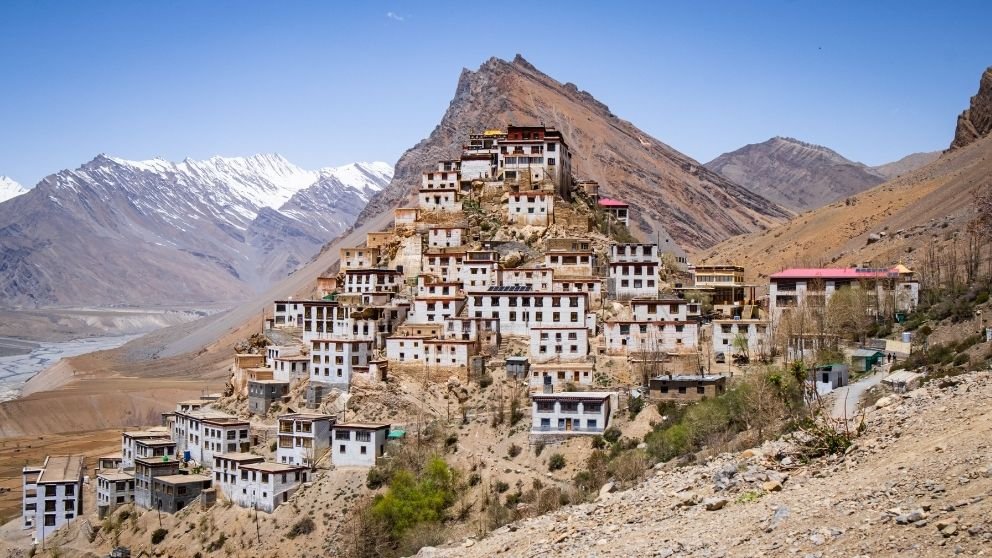
Sitting dramatically above the Spiti River, Key Monastery is one of the most iconic places in Spiti Valley.
Its whitewashed buildings appear to rise one above another from a rocky hill, surrounded by the vast brown mountains of the Trans-Himalayan landscape. From a distance, the monastery almost looks like a small fortress guarding the valley below.
Located around 12 km from Kaza at an elevation of roughly 13,500 feet, Key Monastery—also written as Kee, Ki or Kye Monastery—is considered the largest monastery in Spiti Valley.
For travellers exploring Spiti on a motorcycle, Key is usually one of the first major stops on the popular Kaza → Key → Kibber → Chicham sightseeing route.
But Key Monastery deserves more than a quick photograph.
Behind its spectacular location is a living Buddhist institution filled with prayer rooms, murals, ancient manuscripts, religious paintings and generations of monastic tradition.
Here is everything you should know before visiting Key Monastery in Spiti Valley.
Key Monastery at a Glance
Location: Near Kaza, Spiti Valley, Himachal Pradesh
Distance from Kaza: Approximately 12 km
Altitude: Around 13,500 ft
Also Known As: Kee Monastery, Ki Monastery, Kye Monastery, Key Gompa
Region: Lahaul & Spiti, Himachal Pradesh
Religion: Tibetan Buddhism
Best Base: Kaza
Recommended Visit Duration: Around 1–2 hours
Ideal Route: Kaza → Key Monastery → Kibber → Chicham
The monastery is connected to Kaza by road, making it one of the easiest major monasteries to include while sightseeing around central Spiti.
About Key Monastery
Key Monastery is built on a prominent hill overlooking the Spiti Valley.
Unlike monasteries designed as one symmetrical structure, Key has developed as an irregular collection of rooms, prayer halls, passages and buildings built across different levels.
This layered construction gives Key its unmistakable fortress-like appearance.
Inside, narrow passages lead between prayer chambers, stone staircases and small doorways. Himachal Tourism describes the monastery as a maze of rooms and corridors containing religious paintings, manuscripts, musical instruments and monastic living spaces.
The monastery remains an important centre of Buddhist learning, with monks studying religious philosophy, meditation and other Buddhist teachings here.
For a traveller, this means Key isn’t simply a historic monument.
It is still very much a living monastery.
History of Key Monastery
The exact early history of Key Monastery is not completely settled.
Some historical accounts attribute its foundation to Dromtön, who lived between 1008 and 1064 AD, while other scholars place the monastery’s origins somewhat later. The Lahaul & Spiti district administration notes that scholars differ on the exact foundation date, although there is broad agreement that the monastery existed before the 15th century.
This uncertainty is worth mentioning because Key’s history is often simplified online into a single foundation year.
What is clear is that the monastery has existed for centuries and has developed gradually over time.
Its location and architecture also gave it a defensive character. Key belongs to a type of multi-storeyed monastery architecture that could function as both a religious institution and a fort-like structure.
The monastery has survived periods of conflict and hardship, and its irregular arrangement today reflects centuries of rebuilding, expansion and adaptation.
Why Is Key Monastery Famous?
There are several reasons Key has become one of the most recognizable landmarks in Spiti.
1. Its Incredible Location
Key sits above a vast stretch of the Spiti Valley.
From the monastery and surrounding viewpoints, you can see the Spiti River, cultivated patches of land, tiny settlements and enormous barren mountains stretching into the distance.
The contrast between the white monastery and the brown Himalayan landscape makes it one of the most photographed scenes in Spiti.
2. Its Fortress-Like Architecture
Key doesn’t look like a conventional monastery.
Its buildings appear stacked one above another, with small rooms, passages and staircases forming a dense complex around the hill.
The architecture reflects both the spiritual and defensive history of the monastery.
3. Ancient Buddhist Art and Manuscripts
Key Monastery contains an important collection of thangkas, murals, manuscripts, stucco images and traditional musical instruments. The district administration also records a historic collection of weapons associated with the monastery’s defensive past.
These collections make the experience inside Key quite different from simply viewing the structure from the road.
4. Buddhist Learning
Key remains an important place for monastic education.
Hundreds of lamas have received religious training here, and the monastery continues to play an important role in Buddhist life in the region.
5. The Kalachakra Ceremony
Key Monastery has also hosted major Buddhist religious gatherings.
In August 2000, His Holiness the Dalai Lama conducted a Kalachakra ceremony here, attracting thousands of devotees.
The event became an important chapter in the monastery’s modern history.
What to See Inside Key Monastery
Many visitors photograph the monastery from outside and leave quickly.
Take some time to actually explore it.
Prayer Halls
The monastery contains prayer chambers connected by narrow corridors and stairways.
These spaces are usually much darker and quieter than the bright Himalayan landscape outside, creating an immediate change in atmosphere.
Buddhist Murals
Religious paintings decorate parts of the monastery.
Some reflect centuries-old Buddhist artistic traditions that travelled between Tibet and the Trans-Himalayan regions of India.
Thangka Paintings
Traditional Buddhist thangkas are among Key Monastery’s important religious treasures.
These detailed paintings usually depict Buddhist deities, teachers, mandalas and spiritual themes.
Ancient Manuscripts
The monastery library contains manuscripts associated with Buddhist scriptures, including sacred Tangyur texts.
Traditional Musical Instruments
Key also preserves traditional instruments used during Buddhist ceremonies, including instruments associated with monastic performances and rituals.
The View Over Spiti Valley
Don’t rush out after exploring the monastery.
Spend a little time enjoying the view.
At around 13,500 feet, Key offers an extraordinary perspective over the surrounding valley. The scale of Spiti becomes much easier to appreciate from here.
Key Monastery Viewpoint
One of the best photographs of Key isn’t taken from inside the monastery.
It’s taken from the road and viewpoints across the valley.
From these locations, you can capture the entire monastery sitting on the hill with the Spiti River and mountains behind it.
If you’re travelling on a motorcycle, the ride itself provides several impressive perspectives of Key as the monastery slowly comes into view.
Photography Tip
Morning and late-afternoon light generally gives the mountains more texture than harsh midday sunlight.
However, weather in Spiti changes quickly, so don’t skip a clear view expecting the light to be better later.
Key Monastery Distance from Kaza
Key Monastery is approximately 12 km from Kaza by road.
That makes it an easy half-day or full-day excursion from Kaza when combined with nearby destinations.
A popular sightseeing circuit is:
Kaza → Key Monastery → Kibber → Chicham → Kaza
You can also combine this with other villages depending on your available time and road conditions.
How to Reach Key Monastery
From Kaza
Kaza is the most convenient base.
The 12 km journey can be completed by:
- Motorcycle
- Car
- Taxi
- Local transport when available
For riders, this is one of the most enjoyable short routes around Kaza.
The road gradually climbs above the valley, opening up wider mountain views as you approach Key.
From Shimla
Travellers approaching Spiti from Shimla generally follow:
Shimla → Narkanda → Rampur → Kinnaur → Nako → Tabo → Kaza → Key Monastery
This is also a popular route for a Spiti Valley bike trip because the altitude increases more gradually than approaching directly from the Manali side.
From Manali
When the seasonal high-altitude route is open, travellers can approach Kaza from:
Manali → Atal Tunnel → Gramphu → Batal → Kunzum Pass → Losar → Kaza
From Kaza, continue approximately 12 km towards Key.
The Manali–Kaza connection is seasonal and depends heavily on snow clearance and road conditions, so always check current conditions before planning around this route.