
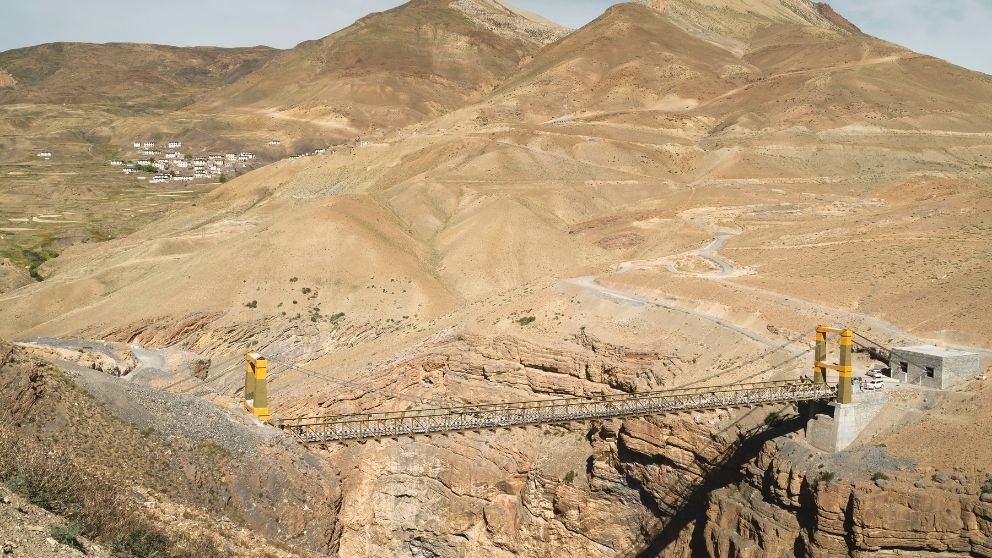
Some places in Spiti Valley are famous for their ancient monasteries. Others attract travellers with beautiful lakes, remote villages or breathtaking mountain passes.
And then there is Chicham Bridge, a remarkable structure suspended between two rocky mountains, high above a deep Himalayan gorge.
At first glance, it might look like another bridge connecting two mountain roads. But when you stand near it and look at the enormous drop below, you realise why it has become one of Spiti Valley’s most photographed landmarks.
Located at approximately 4,145 metres (13,596 feet) above sea level, Chicham Bridge connects the remote villages of Kibber and Chicham in Himachal Pradesh.
For local residents, the bridge changed everyday life by providing a direct road connection across a difficult mountain gorge.
For travellers, it offers an unforgettable combination of engineering, Himalayan scenery and adventure.
Whether you’re exploring Spiti Valley by motorcycle, car or as part of a guided tour, Chicham Bridge is an excellent destination to include in your itinerary.
In this guide, we’ll cover its fascinating history, height, location, routes from Kaza, nearby attractions, best time to visit and practical tips for motorcycle riders.
Where Is Chicham Bridge Located?
Chicham Bridge is located in the Lahaul and Spiti district of Himachal Pradesh, between Kibber Village and Chicham Village.
The bridge crosses the deep Samba Lamba Nallah gorge, surrounded by the dramatic cold-desert mountains of Spiti Valley.
Kaza, the main town of Spiti, is the most convenient base for visiting the bridge.
Travellers generally follow the road from Kaza towards Key Monastery and Kibber before continuing towards Chicham.
The surrounding landscape is typical of high-altitude Spiti: enormous rocky mountains, open valleys, limited vegetation and traditional Himalayan settlements.
Chicham Bridge at a Glance
| Information | Details |
|---|---|
| Location | Spiti Valley, Himachal Pradesh |
| Altitude | Approx. 4,145 metres (13,596 feet) |
| Gorge depth | Approx. 150 metres beneath the bridge |
| Bridge span | Approx. 114–120 metres |
| Completed | 2017 |
| Connects | Kibber and Chicham villages |
| Distance from Kaza | Around 20–25 km, depending on route |
| Nearby village | Kibber |
| Best time to visit | June to September |
| Entry fee | Generally no entry fee |
| Ideal visit duration | 20–30 minutes for the bridge itself |
The bridge is commonly promoted as one of Asia’s highest suspension bridges, although claims about its ranking depend on the measurement used.
Why Is Chicham Bridge So Famous?
There are thousands of bridges across India, but very few are located in an environment as dramatic as Chicham.
The bridge stands at an extraordinary altitude, connecting two sides of a steep mountain gorge in one of India’s most remote inhabited regions.
Its yellow-and-grey towers and steel cables create a striking contrast against the barren mountain landscape.
But what makes Chicham Bridge truly remarkable isn’t simply its height or appearance.
It is the difference the bridge has made to the people living in this region.
A Bridge That Changed Local Connectivity
Before Chicham Bridge was constructed, travelling directly between Kibber and Chicham was difficult.
Although the villages were relatively close geographically, the deep gorge separating them prevented a straightforward road connection.
Residents had to use a much longer road route or rely on a traditional rope-and-pulley crossing to move directly across the gorge.
Crossing the gorge using the old pulley system was challenging, especially in harsh weather.
The completion of Chicham Bridge provided a much safer and more convenient way to travel between the two villages.
Today, motorcycles, cars and local vehicles can cross the gorge using the bridge.
For travellers, the crossing is an adventure. For the local community, it is an important piece of everyday infrastructure.
History of Chicham Bridge: From a Ropeway to a Road Bridge
One of the most fascinating aspects of Chicham Bridge is the story behind its construction.
Building a bridge in a remote region of Spiti Valley is far more complicated than constructing a similar structure in a developed city.
The location presents several challenges, including extreme altitude, freezing winter temperatures, difficult transportation routes and a short working season.
Construction materials, equipment and workers had to reach the remote location through Himalayan roads.
When Was Chicham Bridge Built?
Chicham Bridge was completed in 2017 after a construction period commonly reported to have lasted approximately 14 years.
The bridge was constructed by the Himachal Pradesh Public Works Department.
Its completion represented a major improvement in local connectivity.
The structure spans approximately 114–120 metres across the gorge, with the valley floor roughly 150 metres below.
How Did Villagers Cross Before the Bridge?
Before the bridge opened, a ropeway-like arrangement using a manually operated trolley was one way people crossed directly between the two sides.
Imagine having to cross a deep mountain gorge using a small suspended trolley, with enormous rocky cliffs below.
For local residents, this was part of the practical difficulty of living in a remote Himalayan settlement.
Today, crossing between the villages is considerably easier.
The old crossing system is an important part of the story of Chicham and helps explain why the bridge means much more to residents than simply being a tourist attraction.
Is Chicham Bridge the Highest Bridge in Asia?
You’ll often see Chicham Bridge described online as Asia’s highest suspension bridge or even the world’s highest bridge.
However, there is an important difference between a bridge’s altitude and its structural height.
Chicham Bridge is located at approximately 4,145 metres above sea level.
The gorge beneath the bridge is approximately 150 metres deep.
These two figures represent different measurements.
The bridge is exceptionally high in terms of its location above sea level, but that does not automatically make it the world’s tallest bridge.
Engineering rankings may consider the vertical height of the deck above the ground, the bridge’s structural height or other measurements.
For this reason, it is more accurate to describe Chicham as one of India’s most remarkable high-altitude road bridges rather than make an unqualified world-record claim.
Regardless of its ranking, the experience of standing beside the bridge and looking across the gorge is impressive.
How to Reach Chicham Bridge from Kaza
Kaza is the best starting point for visiting Chicham Bridge.
The journey is relatively short in distance, but it passes through some of the most scenic roads around the town.
Kaza to Chicham Bridge Route
Kaza → Key Monastery → Kibber Village → Chicham Bridge
The road begins in Kaza and climbs towards Key Monastery.
As you gain altitude, the landscape opens up, revealing beautiful views of the Spiti Valley and the surrounding mountains.
Key Monastery is one of the most important Buddhist monasteries in Spiti and makes an excellent first stop.
From there, the road continues towards Kibber Village, a traditional high-altitude settlement surrounded by rocky mountains.
After Kibber, the route continues towards Chicham Bridge.
The final approach offers impressive views of the gorge and the surrounding Himalayan terrain.
Kaza to Chicham Bridge Distance
The bridge is approximately 20–25 kilometres from Kaza, depending on the exact starting point and road alignment.
The journey generally takes around 45 minutes to one hour under favourable road conditions.
However, travelling time can increase because of road construction, snow, traffic or photography stops.
If you plan to explore Key Monastery and Kibber along the way, allow at least half a day.
Can You Reach Chicham Bridge by Motorcycle?
Yes. Chicham Bridge is accessible by motorcycle when the approach roads are open and suitable for travel.
The road from Kaza through Kibber is a popular route among riders exploring Spiti Valley.
However, conditions can change, particularly during the colder months.
Riders should check the latest local road information before departure.
Things to Do at Chicham Bridge
Chicham Bridge isn’t a destination with restaurants, shopping areas or organised adventure activities.
Its main attraction is the extraordinary landscape and the experience of crossing a bridge suspended over a deep gorge.
1. Experience the View from Chicham Bridge
The most memorable experience is seeing the bridge and the gorge from a safe viewing location.
The scale of the landscape is difficult to appreciate from photographs alone.
The rocky canyon drops steeply below, while the surrounding mountains stretch in every direction.
The yellow bridge towers and steel cables stand out against the dry mountain terrain.
Take some time to observe the landscape instead of simply stopping for a quick photograph.
2. Photograph the Bridge and Himalayan Gorge
Chicham Bridge is one of the most recognisable photography locations in Spiti Valley.
There are several opportunities to photograph the bridge against the surrounding mountains.
You can capture its distinctive structural details, the winding approach road and the impressive gorge below.
For motorcycle travellers, the bridge also makes an excellent backdrop for travel photographs.
However, safety is extremely important.
Never stop your motorcycle in the middle of the bridge for a photograph.
Use a safe parking location away from moving traffic, and avoid climbing barriers or standing close to unstable cliff edges.
3. Cross the Bridge
Crossing Chicham Bridge is a memorable experience, particularly if you’re travelling through Spiti Valley for the first time.
As you move across, you can appreciate the depth of the gorge and the scale of the surrounding mountains.
The bridge is an operational road crossing, so vehicles and pedestrians must share the available space responsibly.
Follow any posted restrictions and instructions, and never obstruct traffic for photography.
4. Visit Chicham Village
Once you’ve crossed the bridge from the Kibber side, you can continue towards Chicham Village.
This small settlement offers a glimpse into the traditional lifestyle of upper Spiti.
You may see agricultural fields, local houses and the everyday activities of residents living in this remote Himalayan environment.
The village is peaceful, and the surrounding landscape is particularly beautiful.
If you’re interested in local culture, consider spending some time exploring rather than returning immediately.
Always respect private property and ask permission before photographing residents.
5. Explore Kibber Village
Kibber is one of the most interesting villages near Chicham Bridge.
Situated at approximately 4,270 metres, the village is famous for its traditional houses, high-altitude landscape and proximity to Kibber Wildlife Sanctuary.
Kibber is also known as a base for winter wildlife expeditions focused on observing snow leopards.
During summer, the village offers beautiful mountain scenery and opportunities to learn about local life.
Best Time to Visit Chicham Bridge
The best time to visit Chicham Bridge depends on road access, weather conditions and your overall Spiti Valley travel plans.
Although the bridge is a permanent structure, the road leading to it can be affected by snowfall and seasonal conditions.
May to June: Early Summer
During May and June, temperatures gradually become more comfortable across Spiti Valley.
The mountains may still have snow at higher elevations, making the landscape especially attractive for photography.
However, snow clearance and road conditions can affect access to certain villages.
June is generally a more practical month for regular sightseeing.
July to August: Main Travel Season
July and August are popular months for exploring Spiti Valley.
The high-altitude roads are often accessible when weather conditions are favourable.
Although Spiti receives relatively little monsoon rainfall, the highways leading into the region can still be affected by landslides and rockfall.
Morning visits are often preferable, particularly if you want to combine the bridge with nearby attractions.
September to October: Clear Mountain Views
September is one of the most rewarding months for visiting Chicham Bridge.
Clear skies, crisp mountain air and beautiful autumn light can create excellent photography conditions.
October becomes noticeably colder, and snowfall or icy roads may affect access.
Travellers visiting late in the season should check local conditions carefully.
November to April: Winter Conditions
Winter in upper Spiti is extremely harsh.
Heavy snowfall, freezing temperatures and ice can make roads to Kibber and Chicham difficult or temporarily inaccessible.
The villages remain inhabited, but normal tourist access cannot be assumed.
Winter travel requires suitable equipment, proper local arrangements and reliable road information.
For most travellers, June to September provides the most convenient conditions for visiting Chicham Bridge.
Chicham Bridge on a Spiti Valley Bike Trip
For motorcycle enthusiasts, Chicham Bridge is one of the most enjoyable short excursions from Kaza.
The journey combines scenic mountain roads, high-altitude villages and impressive natural landscapes.
Unlike longer riding days involving hundreds of kilometres, this trip gives you an opportunity to explore at a slower pace.
You can stop at Key Monastery, continue towards Kibber and experience Chicham Bridge before returning to Kaza.
What Makes the Ride Special?
The road gradually climbs from Kaza towards higher mountain settlements.
You’ll experience wide views of the Spiti Valley, sharp mountain curves and the distinctive cold-desert landscape.
As you approach Kibber, the scenery becomes increasingly remote.
The ride towards Chicham Bridge is particularly memorable because the enormous gorge appears unexpectedly amid the rocky surroundings.
Crossing the bridge on a motorcycle is an experience many riders remember long after their Spiti journey ends.
Motorcycle Riding Tips
Before planning your ride to Chicham Bridge, keep these points in mind:
- Start with sufficient fuel: Refuel in Kaza before exploring the nearby villages.
- Check your motorcycle: Make sure the brakes, tyres and other important components are in good condition.
- Ride cautiously: Mountain roads may have loose gravel, narrow turns or damaged surfaces.
- Carry warm clothing: The wind can be cold even during summer.
- Avoid unnecessary stops: Never stop on the bridge or at exposed road sections for photographs.
- Use offline maps: Mobile connectivity may be unreliable.
- Check weather conditions: Snow, ice and sudden weather changes can affect high-altitude routes.
- Avoid riding after dark: Mountain roads are more difficult to navigate when visibility is poor.
At Spiti Riders, we believe a great motorcycle adventure is not only about covering long distances.
Sometimes, a short ride through extraordinary mountain scenery becomes one of the most memorable parts of the journey.
Explore our Spiti Valley Bike Tour Packages to discover guided motorcycle experiences through the region.
Kaza, Key Monastery, Kibber and Chicham Bridge: A Perfect Half-Day Trip
One of the best ways to explore Chicham Bridge is by combining it with the nearby attractions around Kaza.
Suggested Route
Kaza → Key Monastery → Kibber Village → Chicham Bridge → Chicham Village → Kaza
This route provides an excellent combination of Buddhist heritage, traditional village life and Himalayan landscapes.
Stop 1: Key Monastery
Begin your journey from Kaza and travel towards Key Monastery.
The monastery is one of the most recognisable landmarks in Spiti Valley, with traditional buildings constructed on a rocky hillside.
Spend some time exploring the accessible sections and enjoying the surrounding mountain views.
Stop 2: Kibber Village
Continue towards Kibber, a traditional Himalayan village surrounded by the dramatic mountains of upper Spiti.
You can explore the village, enjoy the scenery and experience the quiet atmosphere.
Stop 3: Chicham Bridge
From Kibber, continue towards Chicham Bridge.
Spend approximately 20–30 minutes viewing the bridge, taking photographs and appreciating the gorge.
Allow extra time if you prefer a relaxed visit.
Stop 4: Chicham Village
Cross the bridge and continue into Chicham Village.
Explore the traditional settlement respectfully and enjoy the surrounding high-altitude landscape.
After visiting Chicham, return towards Kaza using a suitable open road.
How Much Time Do You Need?
Allow approximately 4–5 hours for a comfortable trip, including sightseeing, photography and breaks.
The actual duration depends on road conditions and how much time you spend at the monastery and villages.
If you’re planning additional attractions such as Langza, Hikkim or Komic, consider spreading your sightseeing over two days instead of rushing through everything.
Can You Continue Towards Losar from Chicham Bridge?
Yes, there is a road connection from the Chicham side towards the main Kaza–Losar route, via the Kiato area.
This can be useful for travellers continuing towards Losar and Kunzum Pass during the summer travel season.
However, the available route and actual road conditions should be confirmed locally before departure.
If you’re travelling towards Chandratal or Manali, the Chicham connection may be incorporated into a suitable itinerary rather than returning all the way through Kaza.
This approach depends on your planned route, the group’s schedule and road accessibility.
For motorcycle riders, it can be an interesting alternative to visiting the bridge only as an out-and-back sightseeing stop.
Places to Visit Near Chicham Bridge
Several excellent destinations are located near the bridge and can be explored during your Spiti Valley trip.
1. Key Monastery
Key Monastery is one of Spiti’s most important Buddhist monasteries.
Its hilltop architecture, religious heritage and mountain surroundings make it one of the must-visit destinations near Kaza.
2. Kibber Village
Kibber is a traditional high-altitude settlement known for its beautiful landscapes and proximity to Kibber Wildlife Sanctuary.
The village is also associated with winter snow leopard tracking expeditions.
3. Chicham Village
Chicham Village lies across the bridge from Kibber.
Its traditional homes, peaceful atmosphere and remote location make it an interesting cultural stop.
4. Komic Village
Komic is another fascinating high-altitude destination near Kaza.
The village is known for Tangyud Monastery and its reputation as one of the highest inhabited villages connected by road.
Although Komic isn’t directly beside Chicham, it can be explored on a separate high-village sightseeing circuit.
5. Langza Village
Langza is famous for its enormous Buddha statue, mountain views and fossil-rich geological surroundings.
It is particularly attractive for travellers interested in photography and natural history.
6. Hikkim Village
Hikkim is known for its high-altitude post office.
Travellers often visit the village to send postcards from this remote Himalayan location.
Is Chicham Bridge Safe to Visit?
Chicham Bridge is an operational road bridge used by local residents and visitors.
However, its high-altitude environment means that travellers should take sensible precautions.
The surrounding gorge has steep cliffs, and the weather can change rapidly.
When visiting:
- Stay within designated pedestrian areas where provided.
- Never climb railings or cross safety barriers.
- Avoid leaning over unprotected edges.
- Do not stop vehicles in the middle of the bridge.
- Follow posted vehicle restrictions and local instructions.
- Keep children close while visiting the area.
- Avoid visiting during severe weather or icy conditions.
Altitude Safety
At approximately 4,145 metres, the bridge is significantly higher than Kaza.
Travellers arriving rapidly from lower elevations may experience symptoms of altitude sickness.
Headache, nausea, dizziness and unusual fatigue should not be ignored.
Acclimatise appropriately before visiting, avoid unnecessary physical exertion and do not continue ascending if altitude-related symptoms develop.
Severe breathlessness at rest, confusion or difficulty walking require urgent medical attention and descent.
Where to Stay Near Chicham Bridge
There are limited accommodation options around Chicham and Kibber, mainly in the form of local homestays and guesthouses.
If you want to experience traditional village life, staying in Kibber or Chicham may be an interesting option.
However, facilities are generally basic, and availability can vary with the season.
Kaza offers a wider range of accommodation, restaurants and essential services.
For travellers visiting Chicham Bridge as part of a regular Spiti Valley sightseeing itinerary, staying in Kaza is often the more convenient choice.
Because Kibber and Chicham are at high altitude, overnight stays should only be considered after suitable acclimatisation.
Important Travel Tips for Chicham Bridge
A little preparation can help make your visit more comfortable.
Mobile network: Coverage may be unreliable near the bridge and surrounding villages.
Fuel: Kaza is the most practical place to refuel before beginning the trip.
Food and water: Carry drinking water and snacks rather than depending on facilities at the bridge.
Cash: Keep some cash for small local expenses.
Warm clothing: Carry a jacket even during summer because strong winds can make the area feel cold.
Road conditions: Confirm accessibility before departure, particularly during winter and early summer.
Photography: Respect private property and avoid risky positions near the gorge.
Responsible tourism: Carry your waste back and avoid damaging the fragile Himalayan environment.
Frequently Asked Questions About Chicham Bridge
1. Where is Chicham Bridge located?
Chicham Bridge is located in Spiti Valley, Himachal Pradesh, connecting Kibber and Chicham villages across the Samba Lamba Nallah gorge.
2. What is the height of Chicham Bridge?
Chicham Bridge is situated at approximately 4,145 metres (13,596 feet) above sea level. The gorge beneath the bridge is approximately 150 metres deep.
3. Is Chicham Bridge the highest bridge in Asia?
Chicham Bridge is frequently promoted as Asia’s highest suspension bridge. However, this claim is disputed because bridge rankings depend on factors such as elevation above sea level and deck height above the ground.
4. How far is Chicham Bridge from Kaza?
Chicham Bridge is approximately 20–25 kilometres from Kaza, depending on the route. The journey usually takes around 45 minutes to one hour in favourable conditions.
5. When was Chicham Bridge constructed?
Chicham Bridge was completed in 2017 after approximately 14 years of construction work.
6. What is the best time to visit Chicham Bridge?
June to September is generally the most convenient period for regular sightseeing. The road may also be accessible during other months, depending on snowfall and local conditions.
7. Can we cross Chicham Bridge by motorcycle?
Yes. The bridge is used by motorcycles and other permitted road vehicles. Riders should follow local traffic rules and avoid stopping on the bridge for photographs.
8. Is there an entry fee for Chicham Bridge?
There is generally no separate entry fee for visiting the bridge because it is a public road crossing.
9. Can we visit Key Monastery, Kibber and Chicham Bridge in one day?
Yes. These attractions are located along the same general route from Kaza and can comfortably be explored as a half-day or full-day excursion.
10. Can we visit Chicham Bridge during winter?
Winter access depends on snowfall, ice and local road conditions. The bridge itself remains in place, but the approach roads may become difficult or temporarily inaccessible.
11. How long should we spend at Chicham Bridge?
Approximately 20–30 minutes is enough for a short visit and photographs. Travellers can spend longer if they also want to explore Chicham Village.
12. Why is Chicham Bridge important?
Chicham Bridge provides a direct road connection between Kibber and Chicham, improving transportation and accessibility for local residents. It is also an important sightseeing attraction in Spiti Valley.
Final Thoughts: Why Chicham Bridge Deserves a Place in Your Spiti Itinerary
Chicham Bridge is one of those places that perfectly captures the character of Spiti Valley.
It combines an extraordinary Himalayan landscape with an interesting story of engineering and local life.
The deep gorge, dramatic mountains and remarkable location make it a memorable destination for photographers and adventure travellers.
But beyond its appearance, the bridge represents something much more important.
For the people of Kibber and Chicham, it transformed a difficult mountain crossing into a practical road connection.
For motorcycle riders exploring Spiti, the journey towards Chicham Bridge offers an opportunity to experience remote Himalayan roads and villages without travelling too far from Kaza.
Whether you’re standing beside the bridge, exploring Kibber or riding through the surrounding mountains, this part of Spiti leaves a lasting impression.
Planning a Spiti Valley Motorcycle Adventure?
At Spiti Riders, we’re a locally operated team that manages our motorcycle tours directly, rather than simply passing bookings to third-party operators.
Our journeys are designed to help travellers experience the mountain roads, traditional villages and remarkable destinations that make Spiti Valley special.
Explore our Spiti Valley Bike Tour Packages or read our 5-Day Spiti Valley Itinerary for more travel inspiration.
Spiti Riders — Ride Beyond the Ordinary.