
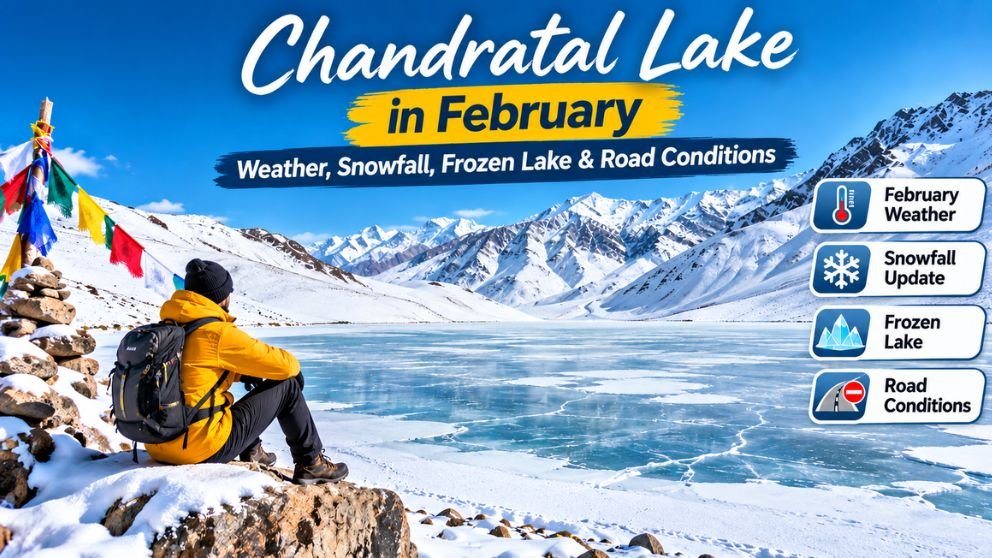
Chandratal Lake in February is one of the most remote and snowbound landscapes in Himachal Pradesh. Situated at approximately 4,300 metres above sea level in the Lahaul and Spiti district, this beautiful Himalayan lake experiences intense winter conditions throughout February.
Unlike the famous turquoise-blue lake seen during the tourist season, Chandratal in February is typically frozen, surrounded by snow-covered mountains and cut off from regular road access.
Many travellers wonder whether February is a good time to experience a frozen Chandratal Lake, see heavy snowfall or plan a motorcycle adventure through Spiti Valley.
However, there is one important fact to understand: Chandratal Lake is generally inaccessible to tourists throughout February because the roads through Batal and Kunzum Pass remain closed due to snow.
This guide explains what Chandratal Lake is like in February, how cold the weather gets, whether the lake remains frozen, the condition of the approach roads and what travellers should know before planning a winter journey.
What Is Chandratal Lake Like in February?
February brings a dramatic winter landscape to Chandratal Lake. The surrounding mountains remain covered in snow, temperatures stay extremely low and the lake usually has extensive ice cover.
Located in a remote alpine basin, Chandratal experiences a much harsher winter than the lower-altitude towns of Himachal Pradesh.
During February, the area generally experiences:
- Extensive snow cover across the surrounding mountains.
- A frozen or largely ice-covered lake surface.
- Extremely cold days and nights.
- Strong winds and possible fresh snowfall.
- Snowbound walking tracks and approach roads.
- No regular tourist camping facilities.
- Very limited human activity near the lake.
One particularly important feature of February is the accumulation of snow from earlier winter storms.
Even when there is no fresh snowfall, previously accumulated snow can continue to block roads and mountain tracks.
The result is a beautiful but exceptionally difficult environment that is unsuitable for regular sightseeing.
Chandratal Lake Weather in February
February is one of the coldest periods in the Chandratal region.
The lake’s high elevation means that freezing conditions can continue throughout the day, while nighttime temperatures may drop considerably further.
Although February can have bright sunshine and clear mountain skies, these conditions should not be mistaken for warm weather.
Chandratal Lake Temperature in February
Temperatures around Chandratal are frequently below freezing during February.
The actual temperature depends on altitude, snowfall, wind speed and the prevailing weather system.
| Weather factor | Typical February conditions |
|---|---|
| Daytime temperature | Very cold, often below freezing |
| Nighttime temperature | Severe sub-zero conditions |
| Snowfall | Possible during winter storms |
| Lake condition | Usually frozen or extensively ice-covered |
| Road condition | Normally closed due to snow |
| Wind | Cold mountain winds, sometimes strong |
| Tourist accessibility | Generally inaccessible |
Because Chandratal has no regular year-round weather station for tourists, exact daily lake temperatures should not be assumed from forecasts for Kaza, Keylong or Manali.
The lake sits significantly higher than many populated areas, and the combination of altitude and wind can make conditions far more severe.
Does It Snow at Chandratal Lake in February?
Yes. Snowfall is common in the high-altitude Chandratal region during February, although individual storms and snow totals vary from year to year.
Western disturbances can bring fresh snow to the Himalayan mountains, sometimes affecting large parts of Lahaul and Spiti.
Fresh February snowfall can add to the snow already covering the terrain.
This can result in:
- Deep snow around the lake basin.
- Snow accumulation on mountain roads.
- Poor visibility during storms.
- Snowdrifts created by strong winds.
- Increased avalanche risks on exposed slopes.
- Further delays to any road-clearing activity.
It is also possible for the weather to remain sunny for several days while the lake and surrounding roads continue to be snowbound.
A clear February forecast does not mean Chandratal Lake is accessible.
Is Chandratal Lake Frozen in February?
Yes. Chandratal Lake is typically frozen during February, when prolonged sub-zero temperatures allow ice to persist across much of the water’s surface.
The lake is famous for its crescent shape and deep-blue water, but February produces a very different appearance.
Instead of an open turquoise lake, the surface may be covered with ice, snow or a combination of both.
The surrounding mountains and the lake basin also remain snow-covered, creating an almost entirely white landscape.
Can You Walk on Frozen Chandratal Lake in February?
Walking on the frozen lake is not recommended.
The appearance of a frozen surface does not indicate that its ice is safe.
Ice thickness can vary because of temperature changes, snow insulation and movement of water beneath the surface.
Snow may conceal thinner ice or cracks.
There is no routinely available, verified ice-safety information that would allow tourists to treat Chandratal as a safe place for walking or recreational activities on the frozen surface.
Even if the lake could be reached, visitors should never attempt to walk across its ice.
Can You Visit Chandratal Lake in February?
For ordinary tourism, Chandratal Lake is not accessible in February.
The main reason is the closure of high-altitude roads connecting the lake with Manali, Batal, Kunzum Pass and Kaza.
The region receives significant winter snowfall, and road access is usually interrupted for several months.
Both major approach routes are affected.
1. Chandratal Lake from Manali in February
The regular approach from Manali runs through the Atal Tunnel region towards Gramphu, Chhatru and Batal before turning towards Chandratal Lake.
During February, the road towards Batal is normally closed because of snow accumulation.
Although the Atal Tunnel provides connectivity between Manali and parts of Lahaul, it does not provide year-round access to Chandratal.
Road conditions beyond Gramphu are entirely different from those on the main tunnel route.
Visitors cannot assume that reaching Sissu or Keylong means that Chandratal is accessible.
February road status: The usual road route from Manali to Chandratal is normally closed.
2. Chandratal Lake from Kaza in February
The second approach starts from Kaza and continues towards Losar, Kunzum Pass and the Chandratal diversion near Batal.
Kunzum Pass is situated at approximately 4,550 metres and receives heavy winter snow.
During February, the pass is normally closed to regular vehicle traffic.
Even travellers who successfully reach Kaza during winter cannot continue to Chandratal along the usual road.
The road beyond Losar can become heavily snowbound, and the mountain pass is not maintained as a regular all-season tourist route.
February road status: The Kaza–Kunzum Pass–Chandratal route is normally closed.
Chandratal Lake Road Status in February
Road closures are the biggest factor affecting Chandratal tourism during February.
Unlike places connected by major winter-maintained highways, Chandratal depends on remote mountain roads that remain snow-covered for long periods.
The final road towards the lake is particularly exposed to severe mountain weather.
| Road section | Normal February status |
|---|---|
| Manali to Atal Tunnel | Subject to winter weather and traffic restrictions |
| Atal Tunnel to Gramphu | Access depends on local road conditions |
| Gramphu to Batal | Normally closed |
| Batal to Chandratal Lake | Snowbound and inaccessible |
| Kaza to Losar | Weather-dependent |
| Losar to Kunzum Pass | Normally closed |
| Kunzum Pass to Chandratal | Inaccessible |
These are typical seasonal conditions, not live road-status reports.
Travellers should always verify road information with local authorities before entering Lahaul or Spiti.
Official information is available through the Lahaul and Spiti District Road Status page.
Does the Chandratal Road Open by the End of February?
No regular reopening should be expected by the end of February.
A few sunny days or a temporary rise in temperature cannot clear the substantial snow accumulation on the mountain approach roads.
Road reopening depends on snow depth, weather conditions, snow-clearing operations and official assessments.
February remains part of the winter closure period, including its final week.
Travellers should not make bookings on the assumption that Chandratal becomes accessible in late February.
Can You Visit Chandratal Lake by Motorcycle in February?
February is not suitable for a conventional Chandratal Lake motorcycle trip.
The challenge is not simply cold-weather riding. The main problem is that the approach roads are generally buried under snow.
Even adventure motorcycles designed for difficult Himalayan terrain cannot safely navigate roads that are completely blocked.
Riding in February also creates other serious risks:
- Black ice and frozen road surfaces.
- Limited tyre grip.
- Extremely cold wind exposure.
- Snow covering road edges and obstacles.
- Reduced visibility during snowfall.
- No dependable roadside assistance near Chandratal.
- Remote stretches with unreliable mobile connectivity.
Motorcycle travellers should never attempt to bypass winter road closures or follow unverified tracks towards the lake.
At Spiti Riders, we encourage riders to plan Himalayan journeys according to actual road accessibility rather than assuming every high-altitude destination is open throughout the year.
Is Camping Possible at Chandratal Lake in February?
No. Regular tourist camping facilities near Chandratal Lake are not available during February.
Chandratal camps operate seasonally and are removed or closed before the severe winter conditions.
During February, travellers should not expect to find functioning tourist camps, restaurants or heated accommodation near the lake.
There are also no dependable local facilities for food, drinking water, medical treatment or emergency vehicle repairs.
Camping in such an isolated environment during severe winter weather would involve substantial risks, including hypothermia and difficulty obtaining rescue assistance.
The lake and its surrounding landscape are also environmentally sensitive, and camping is subject to wildlife protection rules and local restrictions.
February is not a suitable month for recreational camping near Chandratal Lake.
Why Is Chandratal Lake Dangerous in February?
The isolation of Chandratal becomes particularly serious during February because the region remains exposed to severe winter conditions.
1. Deep and Unstable Snow
Snow accumulation can make it impossible to identify roads, footpaths or dangerous terrain.
New snowfall may conceal older ice, rocks and gaps in the ground.
2. Avalanche Risk
The surrounding mountain terrain can be vulnerable to snow instability.
Fresh snowfall, wind-loaded slopes and changing temperatures may increase avalanche hazards.
3. Hypothermia and Frostbite
Extended exposure to severe cold can result in hypothermia and frostbite.
Strong winds can make cold conditions particularly dangerous, even when the sky is clear.
4. High-Altitude Sickness
Chandratal Lake is situated at approximately 4,300 metres above sea level.
At this altitude, reduced oxygen availability can cause acute mountain sickness and potentially life-threatening altitude-related complications.
5. No Immediate Emergency Assistance
The Chandratal area has limited communication coverage and no dependable medical infrastructure.
With roads blocked by snow, emergency evacuation can be extremely difficult.
These risks make February unsuitable for independent sightseeing or an unassisted expedition to the lake.
Can You Explore Spiti Valley in February Instead?
Yes, parts of Spiti Valley may be accessible during February, although a winter journey requires careful planning.
Travellers generally approach the valley through Shimla and Kinnaur because the regular road connection over Kunzum Pass is closed.
Depending on snowfall and road conditions, it may be possible to reach Kaza and explore selected nearby destinations.
February offers a distinctly different experience of Spiti, including snow-covered villages, frozen landscapes and quieter surroundings.
However, visitors should be prepared for temporary road closures, extreme cold and limited accommodation choices.
Places to Consider During a February Spiti Trip
Depending on verified road conditions, travellers may consider:
- Kaza: The main town and a practical winter base when accessible.
- Tabo: A historic settlement that may be reached on the Kinnaur–Spiti route.
- Dhankar: A spectacular hillside village, although its approach road may be difficult or blocked.
- Key Monastery: An important monastery near Kaza, subject to local road accessibility.
Not all of these destinations will necessarily be accessible on the same February trip.
A successful journey to Kaza does not mean that the road to Chandratal is open.
What Should Travellers Know Before Planning Spiti in February?
If you are considering a February trip to Spiti Valley, your planning should prioritise cold-weather preparation and reliable information.
Check official road reports before departure and continue monitoring weather forecasts during the journey.
Choose accommodation that operates during winter and confirm heating arrangements in advance.
Allow additional travel days because snowfall may delay movement between towns or villages.
Carry suitable winter clothing, necessary medication and emergency supplies. A winter-capable vehicle and an experienced local driver can be important, but they do not eliminate the risks of snowbound mountain roads.
Most importantly, do not plan Chandratal Lake as part of your February sightseeing schedule.
Frequently Asked Questions About Chandratal Lake in February
1. Is Chandratal Lake open in February?
No. Chandratal Lake is generally inaccessible to regular tourists during February because the connecting roads through Batal and Kunzum Pass remain closed due to snow.
2. Is Chandratal Lake frozen in February?
Yes, Chandratal Lake typically has extensive ice cover during February. However, the exact condition of the ice varies, and walking on the frozen surface is unsafe.
3. Does Chandratal Lake receive snowfall in February?
Yes. February can bring additional snowfall to the Chandratal region. Snow from earlier winter storms also remains accumulated across the surrounding mountains and access roads.
4. How cold is Chandratal Lake in February?
February is extremely cold at Chandratal. Temperatures can remain below freezing during the day and fall significantly further at night. Wind and snowfall can make conditions even more severe.
5. Can I reach Chandratal Lake from Manali in February?
The normal Manali–Gramphu–Batal route is generally closed in February. The Atal Tunnel does not provide direct winter access to Chandratal Lake.
6. Can I visit Chandratal Lake from Kaza in February?
No regular tourist road access is available. Kunzum Pass, which connects Kaza with the Chandratal approach, is normally closed during February.
7. Is Chandratal Lake accessible at the end of February?
The lake is generally still inaccessible at the end of February. Snowbound roads and the closure of Kunzum Pass mean that travellers should not expect access simply because the month is ending.
8. Can I stay overnight at Chandratal in February?
Regular camps and tourist accommodation near Chandratal Lake do not operate in February. Overnight camping is not recommended because of extreme weather, isolation and lack of emergency facilities.
9. Can I visit Spiti Valley in February?
Yes, certain parts of Spiti may be accessible through Shimla and Kinnaur, depending on prevailing road conditions. However, Chandratal Lake normally remains inaccessible even when Kaza can be reached.
10. Is February suitable for a Chandratal Lake bike trip?
No. February road closures, accumulated snow, black ice and severe cold make a conventional motorcycle journey to Chandratal impractical and dangerous.
Final Thoughts: Is Chandratal Lake Worth Visiting in February?
Chandratal Lake in February represents the extraordinary beauty and harshness of a Himalayan winter.
With its frozen surface, snow-covered mountains and remote alpine surroundings, the lake undergoes a remarkable seasonal transformation.
However, February is not a suitable month for a normal Chandratal Lake visit.
The roads from both Manali and Kaza are generally closed, tourist camps are unavailable, and the surrounding terrain presents serious winter hazards.
Travellers interested in experiencing Spiti during February can explore destinations that remain accessible under current conditions, but Chandratal should not be included in a standard winter itinerary.
At Spiti Riders, we believe that a memorable Himalayan journey begins with accurate local information, responsible route planning and respect for the mountains.
For more information about the lake, its geography, travel routes and surroundings, read our complete Chandratal Lake Travel Guide.
Plan responsibly, follow official road advisories and never attempt to reach Chandratal Lake in February through closed or unsafe mountain routes.